A PA State Tax Lien Lasts 5 Years and Pennsylvania Can Revive It

A Pennsylvania state tax lien is the Department of Revenue’s claim for unpaid state taxes, docketed with the county prothonotary and attached to your property. It puts the Commonwealth ahead of other creditors when a sale, refinance or business transfer closes, and it comes off only after the underlying tax is resolved.
Everything here is about that Department of Revenue lien. County real estate tax claims and tax sales run through county tax claim bureaus under different rules, and nothing below applies to them. If a state lien is holding up a deal right now, talk to our Pennsylvania tax attorneys in Chadds Ford before the settlement date gets any closer.
What the Department’s Lien Attaches To
The Department files a lien when an individual or business has delinquent state taxes, and its own lien page describes it as a charge on real or personal property. It files for every type of state tax, including corporation taxes, sales and use tax, employer withholding, personal income tax, inheritance tax and realty transfer tax.
The personal income tax regulation spells out the mechanics. Under 61 Pa. Code section 119.11, the unpaid tax, interest, penalties and costs become a lien in the Commonwealth’s favor against the taxpayer’s real estate. The lien is perfected once the prothonotary files and dockets it, and the prothonotary indexes it the way judgments are indexed.
What that means in practice is priority. The Department’s page says the lien makes the Commonwealth a creditor that must be paid before a home sale, a business transfer or a new loan can go ahead. It also opens the door to the Department’s heavier tools, which the same page lists as wage garnishment, sales tax and employer withholding citations, and administrative bank attachment.
How to Check Whether One Has Been Filed
Most people find out from the mail. The Department sends a Certified Copy of Lien letter once the lien is filed with the county, and letters can also come from outside law firms the Department hires to enforce liens against taxpayers who live out of state.
To check for yourself, log in to myPATH and open Lien Publication under the Tax Compliance tab. That list covers every state tax lien the Department has filed with a county prothonotary and shows the original lien amount, which may differ from what you owe today after partial payments, interest and penalties. The list updates monthly, so a lien you’ve already satisfied can still show until the next update. Because liens are filed in the county where you live or do business, the prothonotary’s docket is the other place to look.
How Can I Release a Lien From the Pennsylvania Department of Revenue?
You release it by resolving the liability behind it. The Department removes the lien once it has confirmation that the past-due amount is resolved, and its page says the satisfaction process starts about 45 days after that happens. Plan for that gap if a closing is involved, because the payoff and the paperwork don’t land on the same day.
Paying the Balance
Start with a current payoff figure. The Department publishes a Lien Payoff Request Form, REV-1038, for exactly this, and it’s worth using rather than working from the amount on the lien list, which only shows what was originally filed. After the lien is satisfied, the Department sends a lien satisfaction notice. Keep it, because you’ll need it again (see below).
A Payment Arrangement
A payment arrangement settles how you pay, but the Department’s page ties removal of the lien to the liability being resolved. Ask the Department how an arrangement affects the lien before you tell a lender or buyer that it’s handled.
A Lien Filed in Error
If the lien doesn’t belong to you or the balance behind it is wrong, the Department’s Bureau of Compliance is the first call, and its number is printed on the lien page. A dispute about the tax itself is a different track. That’s an appeal of the assessment to the Department’s Board of Appeals, and it runs on its own deadline.
How Long Pennsylvania Has to Collect
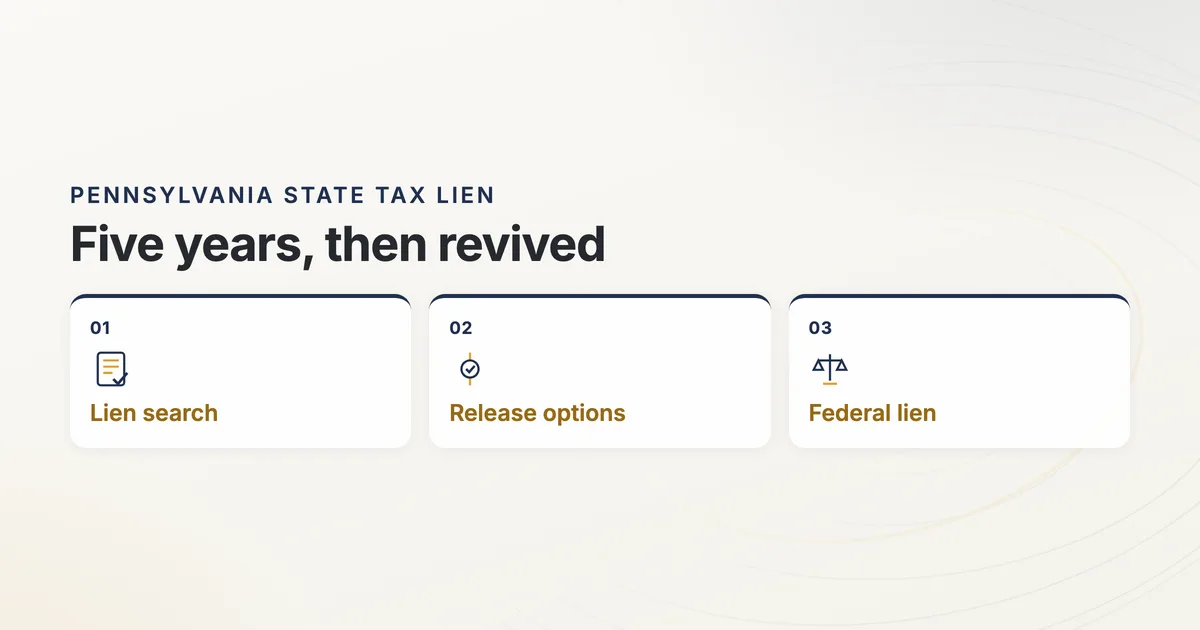
A docketed state lien lasts five years, and it doesn’t stop there. The same regulation says the lien continues for five years from docketing and that the Department may revive and continue it. The Department can also ask the county Court of Common Pleas for a writ of scire facias and take the lien to judgment and execution.
So a five-year lien isn’t a five-year limit on collection. Treat an old Pennsylvania lien as live until the Department’s own records say it’s satisfied. The IRS runs on its own separate ten-year collection clock, and the two don’t move together.
A State Lien and a Federal Lien on the Same Property
Plenty of taxpayers have both, because the same bad year tends to produce a federal balance and a state one. They’re separate liens held by separate governments, and clearing one does nothing to the other.
The federal side has remedies the Department doesn’t offer in the same form. A discharge lifts a federal lien from a single property so a sale can close, which we walk through in our guide to selling property with an IRS lien. Subordination lets a refinancing lender go ahead of the IRS. Our federal tax lien service page sets out how federal tax liens differ and which form each remedy uses.
Credit reports are the other place the two diverge. The Department says it doesn’t report liens to the credit bureaus, but the lien and its cancellation are public records the bureaus can pick up. When the state lien is satisfied, send a copy of the satisfaction notice to the bureaus and ask them to update or remove it. We explain the federal version of that problem in how a federal tax lien affects your credit report.
When a Closing Date Is Already Set
Bring us the settlement date along with the lien letter, because everything works backwards from it. With a satisfaction process that starts about 45 days after the balance is resolved, a closing scheduled for next month needs attention this week. Daniel S. Heller, who is admitted in Pennsylvania, represents clients in disputes with the IRS and state taxing authorities, and Pennsylvania matters start at our Chadds Ford office.
If a Department of Revenue lien is standing between you and a closing or a refinance, contact our Chadds Ford office and tell us the date you’re working to.
FAQ
How to look up a state tax lien?
In Pennsylvania, log in to myPATH and open Lien Publication under the Tax Compliance tab. The list shows every state tax lien the Department of Revenue has filed with a county prothonotary. You can also check the prothonotary’s docket in the county where you live or do business.
How can I release a lien from the Pennsylvania Department of Revenue?
Resolve the tax liability behind it. Request a payoff with Form REV-1038, pay the balance, and the Department starts the lien satisfaction process about 45 days after the liability is resolved, then mails you a satisfaction notice.
What happens if you get a tax lien?
The lien becomes a public record and puts the Commonwealth ahead of other creditors, so a sale, refinance or business transfer can’t close until it’s paid. It also lets the Department move to wage garnishment, citations and bank attachment.
How long can PA collect back taxes?
A Department of Revenue lien continues for five years from the date it’s docketed, and the Department can revive and continue it. The Department can also take the lien to judgment in the county Court of Common Pleas, so an old lien shouldn’t be treated as expired.

About the Author
Gregory McCauley Jr., Esq.
Tax Attorney · Villanova University School of Law · Admitted in Delaware, New Jersey, United States Tax Court
Gregory McCauley Jr. is an experienced tax attorney who has personally represented more than 1,000 clients in matters ranging from civil tax controversy and IRS examinations to criminal tax defense, U.S. Tax Court litigation, and complex business disputes. His practice is built on a foundation his c...