How an Unpaid NJ Tax Debt Becomes a Court Judgment

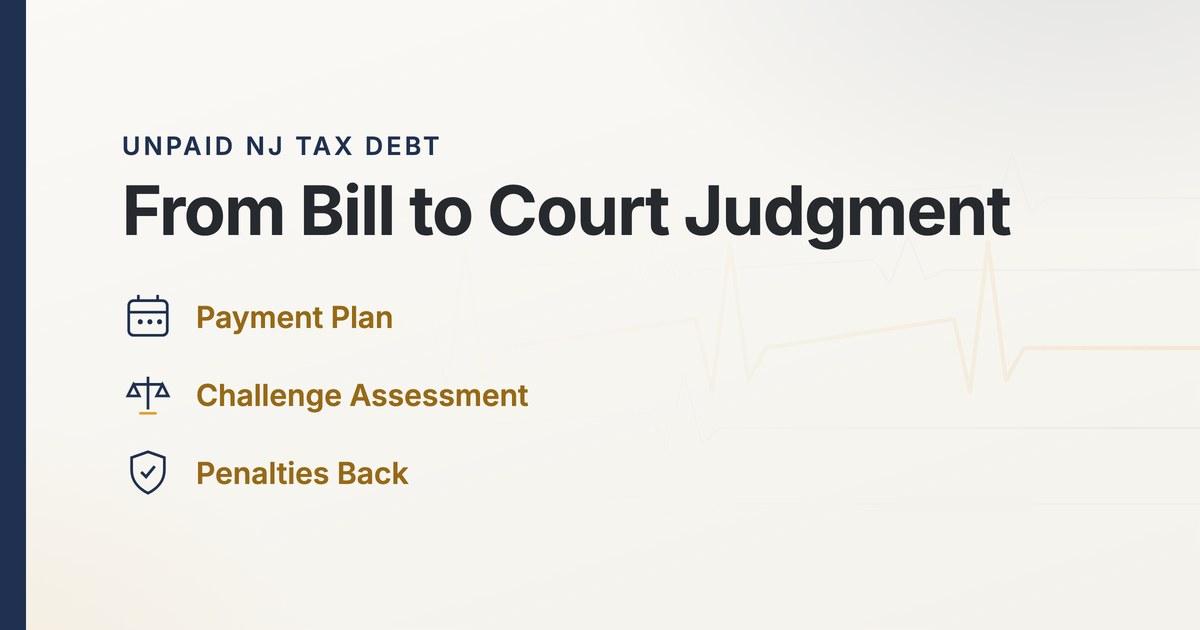
An unpaid New Jersey tax bill picks up interest at the prime rate plus 3 percent, and an account that goes unanswered is sent to the state’s collection vendor with a fee added. If it’s still unpaid, a Certificate of Debt is entered with the Superior Court. That has the force of a docketed judgment and leads to bank levies.
If you’re holding a Division bill, a letter from Coast Professional or notice of a judgment, call our Haddonfield office at (877) 829-5267 or reach us through our contact page. We’ll work out where the account sits before you pay or sign anything.
Finding Out What New Jersey Says You Owe
New Jersey keeps tax debts in more than one system, so one screen may not show everything. The Division’s Tax Portal FAQ says not all tax debts and fees currently appear in the Tax Portal, and it points you to the separate Tax Lookup and Payment Module when a bill’s due date has passed, you’ve received more than one bill for the same debt, you’re on a payment plan, or fees may have been added.
Paper still matters too. Once an account is with the collection vendor, the caseworker mails an updated Schedule of Liabilities, and that document, not the original bill, shows the current balance with fees.
What Happens After the First Unpaid Bill
Interest starts first and doesn’t stop. The Division charges it for every month or part of a month the tax stays unpaid, at the prime rate plus 3 percent compounded annually, according to its page on penalties, interest and collection fees. Penalties stack on top, with a late filing penalty of 5 percent of the tax due per month up to 25 percent, a possible $100 for each month a return is late, and a late payment penalty of 5 percent.
Estimated tax works a little differently. If you owe more than $400 with your return and didn’t make the required estimated payments, the Division can charge interest on the underpayment at 3 percent above prime, even if you pay everything by the return’s due date.
If you don’t respond to a notice by paying the balance or filing the missing return, the Division sends the account to its collection agency. That’s the first real turn in the process.
When the Account Goes to the Collection Vendor
New Jersey’s collection contractor is Coast Professional, Inc., which the Division lists at 1(800) 965-2067 on its collection process page. The vendor assigns a caseworker, who mails an initial contact letter with the Schedule of Liabilities and then tries to reach you by phone.
The referral costs money. A Referral Cost Recovery Fee is added to the liability on top of interest and penalties, and the Division’s fee schedule puts it at 9.85% effective June 15, 2026, down from 11%. Once a caseworker has the file, the Division’s own agents can’t help with it, and you deal with the vendor directly. The Division also warns that the vendor will never ask you to wire money or load a rechargeable card, so a demand like that is a scam.
Our September post covers how a Division of Taxation payment plan works once an account is in this stage.
The Certificate of Debt and What It Does to Property and Credit
A Certificate of Debt is the step that turns a tax bill into a court judgment. If the debt is still outstanding after the vendor stage, a Certificate of Debt is entered with the Clerk of the New Jersey Superior Court, and the Division says it has the same force and effect as a docketed judgment from any court. A Cost of Collection Fee is added to the judgment, and the case goes back to the Division for collection.
The Division’s Judgment Unit calls these certificates the primary vehicle for its collection process. Once one is secured, it uses Warrants of Execution for bank levies and liens on motor vehicles, working with the Motor Vehicle Commission. Our guide to unpaid Corporation Business Tax explains that for a company, the judgment creates a lien on its New Jersey real and personal property and shows up on commercial credit reports.
Getting it satisfied and released
A docketed judgment is satisfied by paying the full balance in certified funds. Your caseworker can give you a payoff figure, and if you don’t have one, the Judgment Unit takes a Judgment Payoff Request Form. A certified copy showing the judgment satisfied comes from the Superior Court Clerk on written request with a $10.00 payment, per the Judgment Unit’s instructions.
Paying in full isn’t the only door. The Division may issue a release or subordination of the lien for a refinance or a foreclosure if it receives documentation supporting hardship. If a judgment is already on file, our New Jersey tax attorneys can tell you which of those routes fits before you call the caseworker.
Refunds and Benefits Taken to Pay the Balance
New Jersey collects from money it would otherwise send you. Under its set-off programs, the Division withholds New Jersey income tax refunds and property tax relief payments, and it sends a notice that gives you 35 days to contact the agency that claimed the debt.
Federal refunds are next in line. If you don’t respond to a bill within 90 days, the Division sends a Notice of Intended Federal Set-Off giving you 60 days, after which your federal refund can be sent to New Jersey, less a federal processing fee. California, Connecticut, Maryland and New York also send their income tax refunds to New Jersey to cover New Jersey tax debts, and businesses that work for the state can see their vendor payments diverted. A payment plan doesn’t switch any of this off until the debt is paid in full.
How Do I Get Out of Tax Debt?
For a New Jersey balance, you get out by paying it, spreading it out, challenging it, or asking for the penalties back. Nothing on the Division’s collection, payment plan or penalty pages offers to forgive the tax itself, so we don’t promise that either.
A payment plan
The Division’s payment plan guidelines set a monthly minimum of $25 and allow standard plans up to 60 months, with interest still running. We won’t repeat the mechanics here, since our September post on the payment plan covers the request, the terms and what happens when a plan breaks down.
Challenging the assessment
If the bill is wrong, pay attention to the date on the notice. You have 90 calendar days from the date of the notice or determination to file a written protest with the Division’s Conference and Appeals Branch, according to its protest guidance. If you disagree with the branch’s Final Determination, you can file a complaint with the Tax Court of New Jersey within 90 days of that determination.
Asking for the penalties back
The Division may waive part or all of a penalty if you show reasonable cause, and for a late payment that means showing undue hardship. Its abatement page is clear about the limit. Interest and collection fees can’t be waived.
If a sale or dissolution is coming
A company that’s dissolving needs a New Jersey tax clearance certificate, and an open balance will stop it. A business selling its assets runs into the same balance through the buyer’s bulk sale notice.
When to Bring In a New Jersey Tax Attorney
Bring us in once a Certificate of Debt is filed, a bank account is levied, or a business sale or dissolution depends on the account. Our attorneys admitted in New Jersey include Gregory McCauley Jr. and Daniel S. Heller.
When the balance is real but can’t be paid at once, our collections defense work covers the options.
If you’re holding a Division of Taxation bill or a judgment notice, book a free consultation and bring the most recent Schedule of Liabilities. New Jersey clients meet with us at our Haddonfield office.
FAQ
How do I get out of tax debt?
For a New Jersey balance, pay it in full, request a payment plan, protest the assessment within 90 days of the notice if it’s wrong, or ask the Division to abate penalties for reasonable cause. Interest and collection fees can’t be waived.
What is the penalty for underpayment of taxes in New Jersey?
If you owe more than $400 with your return and didn’t make the required estimated payments, the Division can charge interest on the underpayment at 3 percent above the prime rate. Separately, paying a tax bill late can bring a 5 percent late payment penalty plus interest.
How to check if you owe NJ state taxes?
Start with the NJ Tax Portal, but the Division says not every debt appears there. Use the Division’s Tax Lookup and Payment Module if a bill’s due date has passed, you’re on a payment plan, or fees may have been added. A Schedule of Liabilities from the collection vendor shows the current balance.

About the Author
Gregory McCauley Jr., Esq.
Tax Attorney · Villanova University School of Law · Admitted in Delaware, New Jersey, United States Tax Court
Gregory McCauley Jr. is an experienced tax attorney who has personally represented more than 1,000 clients in matters ranging from civil tax controversy and IRS examinations to criminal tax defense, U.S. Tax Court litigation, and complex business disputes. His practice is built on a foundation his c...