Is Tax Fraud the Same as Tax Evasion?

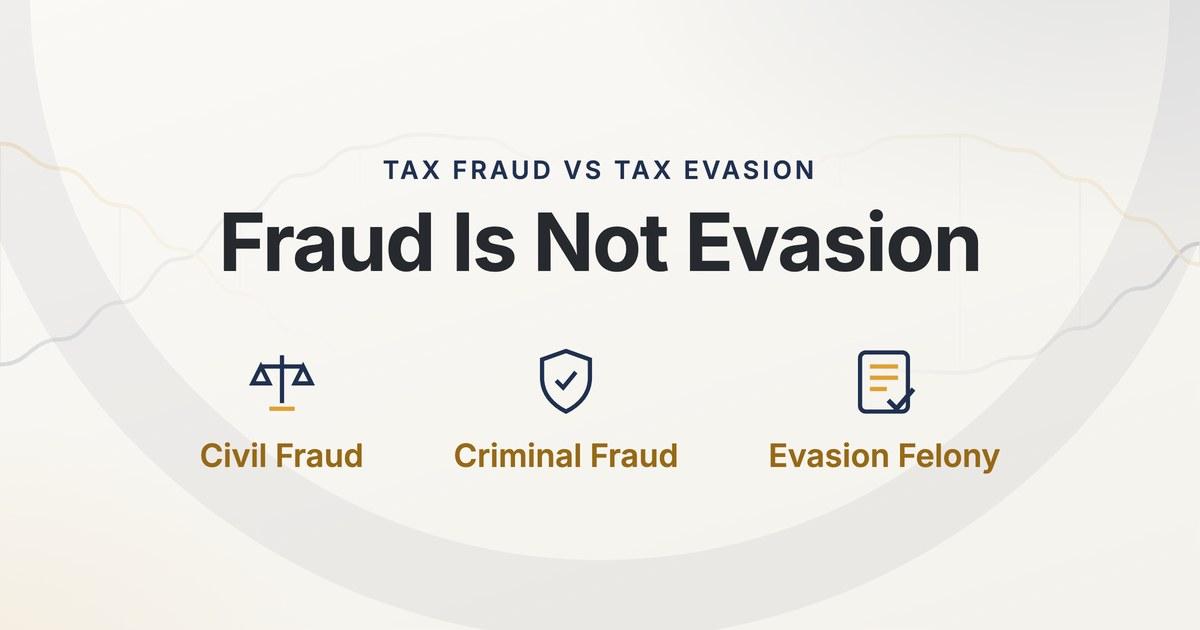
No. Tax fraud is the umbrella term for intentional deception about taxes, and it can be civil, with a 75 percent penalty under section 6663, or criminal. Tax evasion is one specific felony, section 7201, a willful attempt to evade or defeat a tax that the government has to prove beyond a reasonable doubt.
If you’re asking because of your own returns, talk to a lawyer before you talk to anyone else. What you tell our attorneys is protected by attorney-client privilege, and our tax evasion defense work starts with a confidential look at exactly what happened.
What Qualifies as Tax Fraud?
Tax fraud is deliberate deception about a tax, and the law deals with it on two tracks. The IRS’s own fraud handbook, IRM 25.1.2, describes the conduct as actions taken “to deceive or defraud.” On the civil side, section 6663 adds a penalty equal to 75 percent of the part of an underpayment that’s due to fraud. The criminal side is a set of separate offenses, from evasion under section 7201 to a false return under section 7206(1).
An honest mistake isn’t fraud on either track. The difference between tax avoidance, which is legal, and tax evasion comes down to intent.
What Makes Evasion Its Own Crime
Evasion is the most serious charge in the group because of what it requires and what it carries. Section 7201 makes it a felony to willfully attempt “in any manner to evade or defeat any tax” or its payment, with up to 5 years in prison. The statute caps the fine at $100,000, or $500,000 for a corporation, and the general federal fine statute, 18 U.S.C. section 3571, raises the ceiling for an individual’s felony to $250,000.
To convict, prosecutors have to prove three things beyond a reasonable doubt. There has to be tax owed beyond what was reported or paid. There has to be an affirmative act of evasion, such as hiding income, inflating deductions or concealing assets. And it has to be willful, meaning a known legal duty was violated on purpose. Simply failing to file or pay isn’t evasion on its own.
The closest related charge is filing a false return. Under section 7206(1), signing a return under penalties of perjury that you don’t believe is true on every material matter is a felony carrying up to 3 years. No tax loss has to be proven, which is why prosecutors often charge it alongside evasion, as our page on a false return charge under section 7206 explains.
Where Legal Tax Avoidance Ends
Avoidance is planning within the rules, and it stays legal however much tax it saves. Using deductions, credits and structures the tax code allows is your right. It turns criminal only when there’s a willful attempt to deceive the IRS, such as income left off on purpose or a deduction invented to cover a personal expense.
That’s why the same transaction can be fine in one file and a problem in another. A business that pays a family member a salary for real work is planning. A business that books invented invoices to cover personal spending is doing the kind of thing the IRS lists among its fraud indicators.
Civil Fraud and Criminal Fraud Side by Side
The two tracks differ most in who carries the burden and how heavy it is.
| Civil fraud | Criminal evasion | |
|---|---|---|
| Statute | Section 6663 | Section 7201 |
| Where it’s fought | IRS examination, then usually the Tax Court | Federal district court |
| Standard of proof | Clear and convincing evidence | Beyond a reasonable doubt |
| Consequence | 75% of the underpayment due to fraud, plus the tax | Up to 5 years in prison and a fine |
The civil standard comes from Tax Court Rule 142(b), which puts the burden on the IRS and requires clear and convincing evidence. Section 7454 also places the burden of proof on the IRS when fraud is at issue. Once the IRS proves that any part of an underpayment is fraud, section 6663 treats the whole underpayment as fraud unless the taxpayer shows otherwise. Civil and criminal fraud can both apply to the same conduct.
How Does IRS Prove Tax Fraud?
The IRS proves fraud with patterns, because people rarely admit intent. Its examiners work from a published list of fraud indicators, sometimes called badges of fraud, set out in IRM 25.1.2. The manual groups them by income, deductions, records, conduct and concealment.
On income, the list includes omitting entire sources of income, unexplained bank deposits well above reported income, and concealed bank, brokerage or crypto accounts. On records, it names multiple sets of books, false entries and backdated documents. On conduct, it lists false statements about a material fact during an examination, destroying records after an audit starts, and a pattern of underreporting over several years.
The manual adds a caution of its own. It says no single indicator proves fraud, and that fraud is substantiated by establishing affirmative acts.
The Tax Fraud Cases IRS Criminal Investigation Opens Most
No official source ranks every kind of tax fraud, but IRS Criminal Investigation’s case counts show where its tax work concentrates. In its 2025 annual report, non-filer investigations led the tax-specific programs with 245 opened in fiscal year 2025, ahead of abusive return preparer cases at 206 and employment tax cases at 205.
Business owners should note the employment tax line. Our hub on criminal tax defense covers payroll tax fraud alongside the trust fund recovery penalty.
Prison Rates in Federal Tax Fraud Cases
Prison is the more likely result once a tax fraud case reaches sentencing. The U.S. Sentencing Commission’s Quick Facts on tax fraud for fiscal year 2025 reports 324 people sentenced for tax fraud, 68% of them to prison, with an average sentence of 17 months. The District of New Jersey had the second-most tax fraud cases in the country that year, with 24.
Those are averages across federal cases, not a forecast for any one person. The statutory maximums are the outer limit, 5 years per count for evasion and 3 for a false return. Civil collection of the tax runs on its own, separate clock, which we explain in our post on the IRS collection clock.
When to Call a Criminal Tax Attorney
Call before you answer anyone’s questions. If an IRS special agent contacts you, your spouse, your accountant or your employees, say nothing beyond your name and that you want counsel, then call us. Your accountant’s conversations aren’t protected in a criminal matter, so we put a Kovel arrangement in place when an accountant’s help is needed.
Our criminal tax team includes Gregory McCauley Jr., who defends taxpayers under IRS-CI investigation. If you’re worried about a past return, or an agent has already called, contact us before you respond to anyone.
FAQ
What is the most common type of tax fraud?
No official source ranks every type. In IRS Criminal Investigation’s fiscal year 2025 report, non-filer investigations led the tax-specific programs with 245 opened, followed by abusive return preparer cases at 206 and employment tax cases at 205.
What qualifies as tax fraud?
Deliberate deception about a tax, such as leaving income off a return on purpose, claiming invented deductions or keeping false books. It can lead to a civil penalty of 75% of the fraudulent underpayment, criminal charges, or both. Honest mistakes don’t qualify.
How does IRS prove tax fraud?
Through circumstantial patterns its manual calls indicators of fraud, such as omitted income sources, unexplained deposits, double books, false statements to an examiner and concealed accounts. In a civil case the IRS must prove fraud by clear and convincing evidence, and in a criminal case beyond a reasonable doubt.
Do people go to jail for tax fraud?
Many do once they’re sentenced. The U.S. Sentencing Commission reports that 68% of the 324 people sentenced for tax fraud in fiscal year 2025 went to prison, with an average sentence of 17 months. Evasion carries up to 5 years per count.

About the Author
Gregory McCauley Jr., Esq.
Tax Attorney · Villanova University School of Law · Admitted in Delaware, New Jersey, United States Tax Court
Gregory McCauley Jr. is an experienced tax attorney who has personally represented more than 1,000 clients in matters ranging from civil tax controversy and IRS examinations to criminal tax defense, U.S. Tax Court litigation, and complex business disputes. His practice is built on a foundation his c...