How Many Days Do You Have to Petition the PA Board of Appeals?

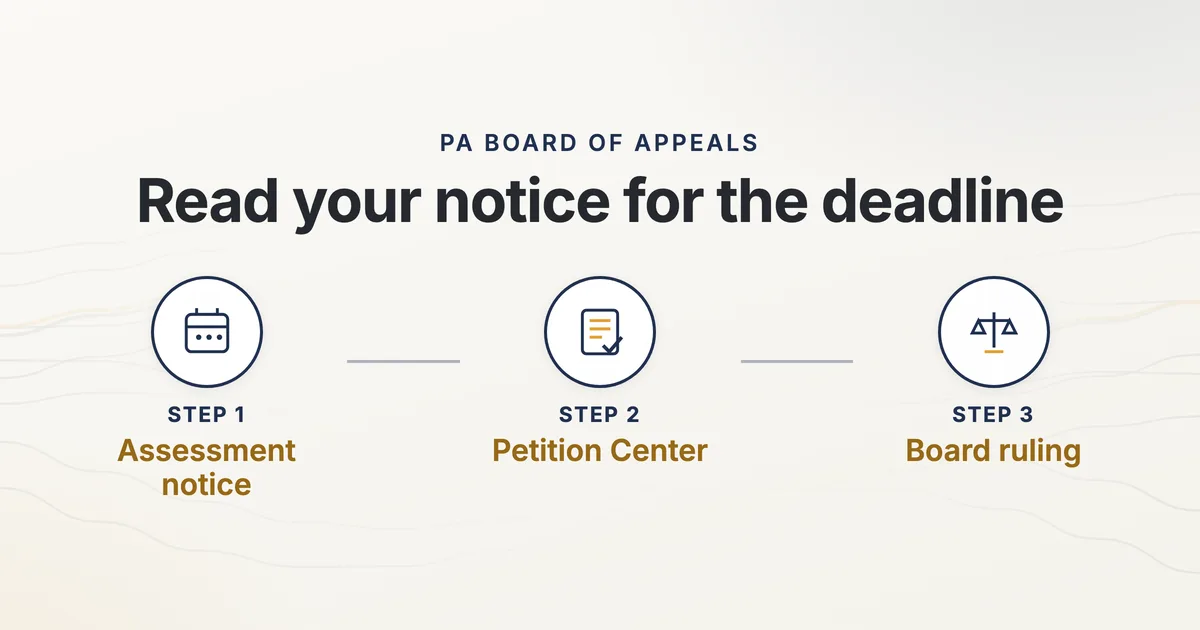
You have 90 days to petition the PA Board of Appeals on a personal income tax or corporate net income tax assessment, and the deadline that governs you is the one printed on your Notice of Assessment. The Board is the Department of Revenue’s first-level review for state tax assessments and refund denials. You petition it through the Online Petition Center or by mail.
Miss the window and the assessment generally becomes final, which is why the date on the notice matters more than anything else in it. If you’re holding a Pennsylvania notice you disagree with, our Pennsylvania tax attorneys can tell you quickly whether it’s worth contesting.
What the Board of Appeals Decides and What It Doesn’t
The Board reviews the Department’s own actions. According to the Department’s tax appeals page, that means initial actions against a taxpayer such as an assessment, refund requests, and denials of Property Tax/Rent Rebate claims and charitable exemptions.
It doesn’t hear county property assessment disputes. A challenge to the assessed value of your house goes to your county’s assessment appeals board, which is a different body with its own calendar. It doesn’t hear IRS matters either. A federal dispute goes through the IRS Office of Appeals, and our IRS appeals practice explains why an Appeals Officer’s settlement authority changes that conversation.
How Do You File an Appeal in Pennsylvania?
You file a petition with the Board of Appeals, online or by mail, before the deadline on your notice. Online petitions go through the Department’s Online Petition Center, which issues a confirmation number you should keep. The Board doesn’t accept petitions by email or fax.
The Deadline After a Notice of Assessment
Your Notice of Assessment states how long you have, and the Department’s page tells taxpayers to read it for exactly that. Act 123 of 2024 restored a 90-day window for personal income tax assessments, up from 60 days, for appeals to both the Board of Appeals and the Board of Finance and Revenue, according to Cozen O’Connor’s summary of the new law, and it took effect on January 27, 2025. The same law allows an extension for cause of no more than 30 extra days. Our guide to Pennsylvania Corporate Net Income Tax sets out the 90-day window for those assessments.
Refund claims run on a different clock. The Department’s page says a petition for refund has to be filed within the period set by the statute for that particular tax, and any petition counts as on time if the Board receives it, or the Postal Service postmarks it, by the last day.
Don’t count on the extension. “For cause” isn’t defined in the statute, and a late petition that depends on it is a weak place to start.
The Online Petition Center
An electronic petition is filed on the date it’s submitted, and you have until midnight Eastern time for it to count on that day. A mailed petition is filed on its U.S. Postal Service postmark date. Exhibits that won’t attach can follow by mail, as long as the petition says so in its issues and arguments section. The Board’s phone number is 717-783-3664, and forms are also available by calling 1-888-PATAXES.
What a Strong Petition Contains
A strong petition proves the Department wrong, because the burden of proof sits with the taxpayer on every issue except fraud. That means documents. The Department requires businesses and representatives to submit supporting evidence electronically, including powers of attorney, legal documents, appeal schedules and proof of payment, and it asks people filing on their own to do the same.
You don’t need a representative, but anyone who represents you must be authorized in writing. Hearings happen at your request or when the Board requires one, and they’re held virtually, recorded, with witnesses testifying under oath. You can also waive the hearing and ask for a decision on the written record. If a hearing date doesn’t work, the Board needs a written continuance request five business days ahead.
A petition can also ask to settle. The Department takes a Request for Compromise, Form DBA-10, with the petition or as soon as possible after it’s filed.
After the Board Rules
The Board issues a written decision, which may include findings of fact and a discussion of the law, and it emails orders to petitioners who have an email address on record.
The Board of Finance and Revenue
If you disagree with the decision, the next stop for all taxes is the Board of Finance and Revenue, which sits within the Treasury Department rather than Revenue. Act 123 added a settlement conference there, which either side can request within 30 days of filing, led by settlement officers who must be attorneys or certified public accountants independent of both departments. Inheritance tax assessments that don’t involve a refund go to the Orphans’ Court Division of the county Court of Common Pleas instead, and compromise orders can’t be appealed at all.
Commonwealth Court
A decision from the Board of Finance and Revenue can be taken further, to Commonwealth Court. By then the dispute is court litigation with its own filing rules, so it pays to treat the Board of Appeals petition as the start of a case rather than a form to get out of the way.
Collection While the Appeal Is Pending
An appeal challenges the assessment, and it’s worth asking the Department directly what it will and won’t pursue on your account while the petition is open. Any tax you don’t dispute is still owed. If a Department of Revenue lien is already filed, it’s a separate track with its own release process, which we cover in our post on Pennsylvania state tax liens earlier this month. For balances you aren’t contesting, our collections defense work covers the options.
Where a Pennsylvania Tax Attorney Fits In
The Board says professional representation isn’t necessary, and for a simple, well-documented dispute that’s true. Where the facts are contested, the amount is significant, or the case may go on to Commonwealth Court, the petition and the record deserve a lawyer’s hand from the first filing. Gregory M. McCauley, our founder, is admitted in Pennsylvania and before the United States Tax Court, and our Chadds Ford office handles Pennsylvania matters.
If you’re counting days from a Notice of Assessment, contact us with the notice date and we’ll tell you how much time is left and what the petition needs.
FAQ
How to file an appeal in Pennsylvania?
For a state tax assessment, file a petition with the Department of Revenue’s Board of Appeals before the deadline on your Notice of Assessment. You can file online through the Online Petition Center or by mail. The Board doesn’t accept petitions by email or fax.
How can I contact the Pennsylvania Board of Appeals?
Call the Board at 717-783-3664. Forms are available through the Online Petition Center or by calling 1-888-PATAXES, and technical problems with an online petition go to the email address listed on the Department’s tax appeals page.

About the Author
Gregory McCauley Jr., Esq.
Tax Attorney · Villanova University School of Law · Admitted in Delaware, New Jersey, United States Tax Court
Gregory McCauley Jr. is an experienced tax attorney who has personally represented more than 1,000 clients in matters ranging from civil tax controversy and IRS examinations to criminal tax defense, U.S. Tax Court litigation, and complex business disputes. His practice is built on a foundation his c...