An NJ Bulk Sale Can Leave the Buyer Owing the Seller's State Taxes

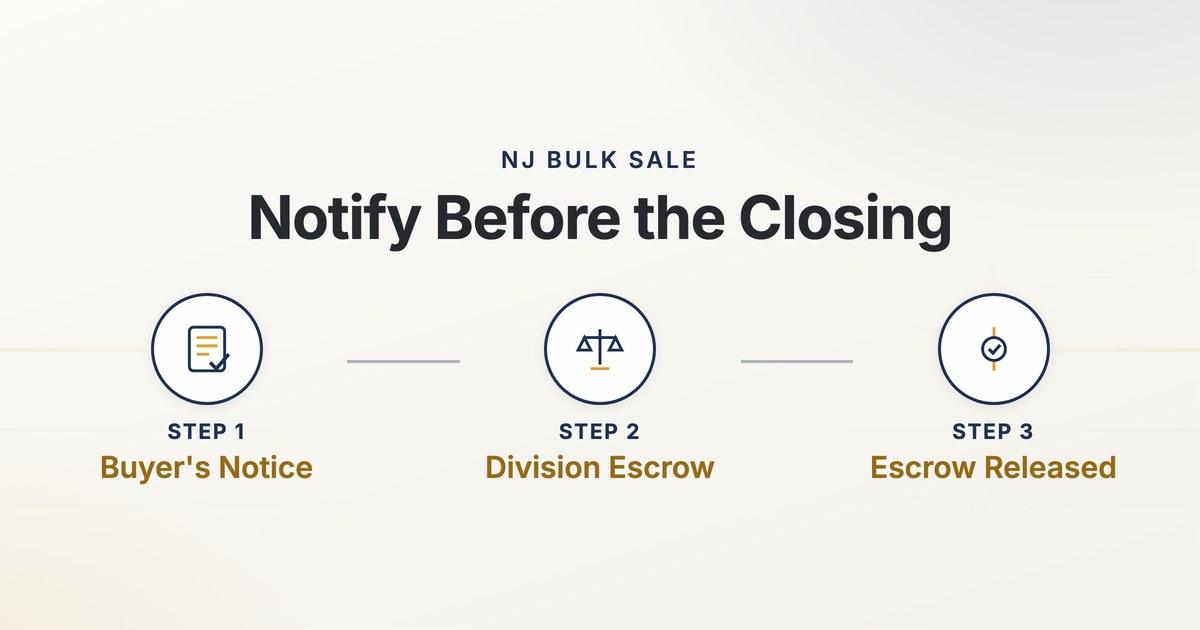
When a New Jersey business sells its assets outside the ordinary course, the buyer must file Form C-9600 with the Division of Taxation at least 10 business days before closing. The Division can then order part of the price held in escrow for the seller’s state taxes, and a buyer who skips the notice can end up owing them.
If you’re the seller and a Division escrow letter is holding up your closing, call our Haddonfield office at (877) 829-5267 or send us the letter through our contact page. The escrow figure comes from the seller’s own tax account, so clearing that account is what frees the money.
What Constitutes a Bulk Sale?
A bulk sale is the sale, transfer or assignment of a business’s assets, in whole or in part, outside the ordinary course of business. The Division’s bulk sale page lists inventory and materials, land and buildings, and intangibles such as goodwill among the assets it covers. Sales to customers aren’t bulk sales, and neither is anything else a business does in its ordinary course.
The definition is broad. The Division’s bulk sale FAQ treats a retiring mechanic who sells his shop, tools and inventory as a bulk sale, and it says the same of a baker who gives his bakery and equipment away as a gift. Real estate used for business or income counts, vacant land counts when it’s a business asset, and a company selling stock it holds in another company has to notify too.
One carve-out matters to a lot of landlords. A one or two family residence owned by individuals, estates or trusts is exempt, and since January 9, 2018 the exemption covers any combination of them, so relatives who co-own and sell a rental don’t file. It doesn’t apply when a business owns the same house.
The Notice Comes From the Buyer’s Side
The buyer, or the buyer’s attorney, has to file the notice, and the FAQ is explicit that a filing by the seller or anyone else doesn’t protect the buyer. A complete notice is Form C-9600 with both parties’ New Jersey tax ID numbers, a specific closing date at least 10 business days out, mailing addresses, the buyer’s or attorney’s signature, and a copy of the signed contract showing the price and terms.
Delivery is old-fashioned. The Division takes the package only by registered, certified or overnight mail, or through a carrier such as FedEx or UPS, and it won’t accept hand delivery or a fax. There’s no filing fee. Business days exclude weekends and holidays, so a notice mailed the week of Thanksgiving gives you fewer working days than the calendar shows.
How Long Does Bulk Sale Take in NJ?
Plan on at least 10 business days after the Division receives a complete notice. The Division says it will respond within 10 business days of receipt, it won’t expedite, and if it misses that window the buyer isn’t liable for the seller’s state taxes. An incomplete filing restarts the count, because on an insufficient notice the 10 days run from the date the Division has everything it asked for.
The answer arrives by first-class mail as one or more of five letters. A clearance letter means no escrow and no assumed obligation, and an escrow letter names the amount to hold back at closing. A returns-required letter goes to the seller and lists what must be filed and paid. An insufficient-notice letter lists what’s missing, and a violation letter tells the buyer it has taken on the seller’s tax obligation.
When the Division Asks for an Escrow
An escrow is a specific amount the Division requires the buyer to withhold from the sale proceeds, held by the buyer or the buyer’s escrow agent. The Division builds the figure from what it already knows about the seller, including established tax obligations, audit findings and unfiled returns.
What the seller’s open balance does to the closing
The escrow can be bigger than the deal. The FAQ cites a 1980 New Jersey Tax Court decision, Bunting v. Director, for the point that a buyer may take on personal liability for the seller’s delinquent taxes beyond the price paid for the assets. When the proceeds can’t cover the required amount, the buyer still has to hold it, and the two sides decide between themselves who brings the difference to closing.
Getting the escrow released
The seller can bring the escrow down by paying deficiencies or audit assessments and by filing and paying any delinquent returns. Once the Division is satisfied that every one of the seller’s obligations is met, it sends the buyer a clearance letter, and the rest of the escrow goes to the seller.
If the seller is a corporation behind on its Corporation Business Tax, our guide to unpaid Corporation Business Tax explains how that balance becomes a Certificate of Debt filed with the Superior Court. Sellers in that spot should call us before the closing date, not after it. Our New Jersey tax attorneys work on the seller’s side of the file, handling the missing returns and the balance the escrow is being held to cover.
What Happens to a Buyer Who Skips the Notice
A buyer who doesn’t give complete and timely notice is responsible for any state tax obligations resulting from the sale. The Division can collect the seller’s debt through judgment, levy and seizure of the buyer’s assets as well as the seller’s. Closing before the 10 business days are up, with no escrow assigned, is a violation as well.
A handshake escrow doesn’t fix it. If the parties close without notifying the Division and simply agree between themselves on an amount to hold back, the Division still treats the sale as a violation, because it was never party to that agreement.
Pennsylvania Runs Its Own Version
New Jersey isn’t the only state with a tax bulk sale rule. Pennsylvania requires notice to its Department of Revenue 10 days before a sale of 51 percent or more of a business’s goods, fixtures, equipment, buildings or real estate, and a buyer who doesn’t get the seller’s clearance certificate can become liable for the seller’s unpaid taxes, according to the Department’s bulk sale procedures.
Those tax rules are separate from the old commercial bulk transfer law. In 1989 the drafters of the Uniform Commercial Code offered states a choice between repealing Article 6 or adopting a revised version. A deal with assets in more than one state needs each state’s tax rule checked on its own.
Clearing the Seller’s Balance Before the Sale
The smoothest closing is one where the Division has nothing to escrow. A seller who knows about an old balance can pay it, or ask for a Division of Taxation payment plan, though the debt stays on the books until it’s paid in full.
A corporation that’s dissolving as well as selling also needs a New Jersey tax clearance certificate, which is a separate request with its own rules. Our attorneys include Gregory McCauley Jr., who is admitted in New Jersey, Delaware and the United States Tax Court.
If you’re selling a New Jersey business with a state balance in the background, book a free consultation and bring the contract and any Division notices. New Jersey clients meet with us at our Haddonfield office.
FAQ
How long does bulk sale take in NJ?
The buyer has to file at least 10 business days before closing, and the Division says it responds within 10 business days of receiving a complete notice. It doesn’t expedite, and if it misses that window the buyer isn’t liable for the seller’s state taxes.
Which states still have bulk sales laws?
New Jersey and Pennsylvania both keep tax bulk sale rules. Pennsylvania requires 10 days’ notice to its Department of Revenue before a sale of 51 percent or more of certain business assets. The older commercial bulk transfer law is a different story, since in 1989 the drafters of the Uniform Commercial Code offered states a choice between repealing Article 6 and adopting a revised version. For assets in any other state, check that state’s revenue department before closing.
What are the requirements for a bulk sale in New Jersey?
The buyer or the buyer’s attorney files Form C-9600 with a copy of the signed contract at least 10 business days before closing, by registered, certified or overnight mail. The form needs both parties’ New Jersey tax ID numbers, a specific closing date, addresses and the buyer’s signature.
Who pays bulk sales tax in NJ?
There’s no separate bulk sales tax. The notice lets the Division collect the seller’s own unpaid state taxes from the sale through an escrow the buyer holds. If the buyer skips the notice, the buyer becomes responsible for the seller’s state tax obligations.

About the Author
Gregory McCauley Jr., Esq.
Tax Attorney · Villanova University School of Law · Admitted in Delaware, New Jersey, United States Tax Court
Gregory McCauley Jr. is an experienced tax attorney who has personally represented more than 1,000 clients in matters ranging from civil tax controversy and IRS examinations to criminal tax defense, U.S. Tax Court litigation, and complex business disputes. His practice is built on a foundation his c...