The PA Tax Clearance Certificate for Selling or Closing a Business

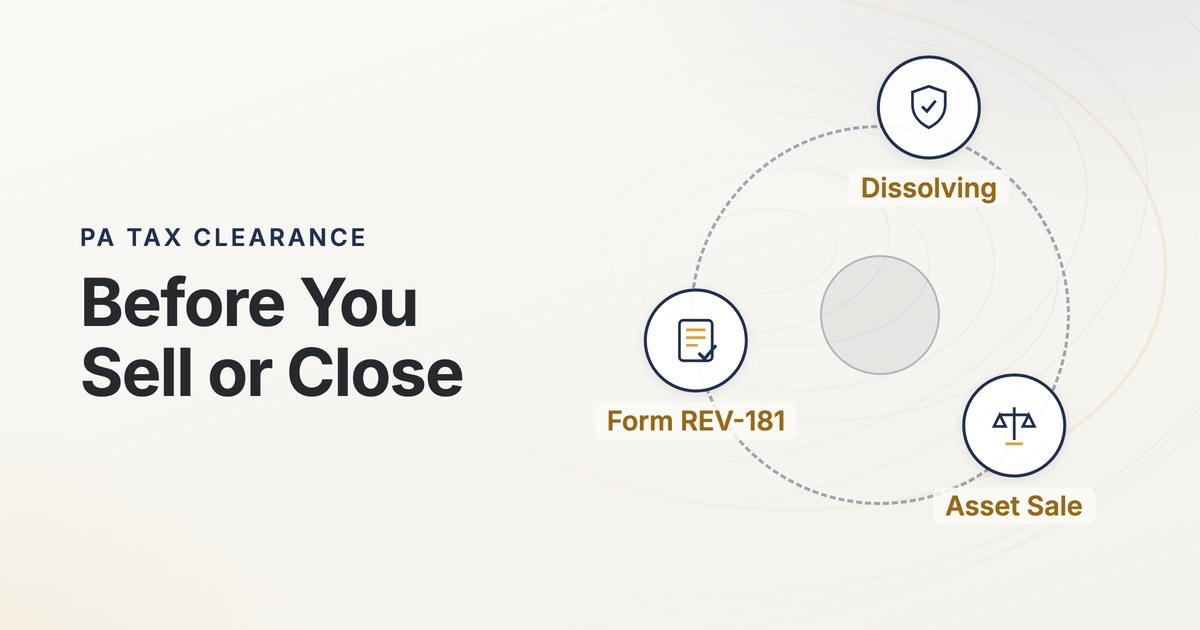
A Pennsylvania tax clearance certificate is the state’s confirmation that a business has satisfied everything it owes the Commonwealth. It’s issued after an application on Form REV-181 to the Department of Revenue and the Department of Labor and Industry. A corporation needs one before the Department of State will accept its dissolution, and a seller needs one after a bulk sale.
An unpaid tax or a missing report stops both. If the Department has written back with a list of outstanding items, talk to our Pennsylvania tax attorneys about clearing them so the certificate can issue.
What a Pennsylvania Clearance Certificate Proves
It’s proof that an entity has satisfied all of its obligations to the Commonwealth, including taxes, interest, penalties, fees and other charges. The Department of Revenue’s instructions for securing a tax clearance certificate (REV-181-I) call it the first step to stop doing business in Pennsylvania, and the definition of an entity is broad, covering corporations, limited partnerships and LLCs, domestic and foreign, for-profit and nonprofit.
Two agencies sign off, not one. Revenue checks the state taxes, and the Department of Labor and Industry checks unemployment compensation tax, which is why the application goes to both. The REV-181 form itself carries no filing fee.
City taxes are a separate matter. Philadelphia issues its own tax clearance for City taxes, which this post doesn’t cover.
The Two Moments a Pennsylvania Business Needs One
The certificate comes up at two points, when the business itself is ending and when it sells off its assets in bulk.
Dissolving, withdrawing or merging out of state
The Department of State won’t accept certain filings without clearance from both Revenue and Labor and Industry. The REV-181-I lists them, and they include articles or a certificate of dissolution, a statement of revival, a merger into a foreign association not qualified here, a division into such associations, and a foreign association’s application to terminate its authority. A court can’t order the dissolution of a domestic corporation, or approve a final distribution of a partnership’s or LLC’s assets, until the certificate is filed with it.
Selling 51 percent or more of the business’s assets
A sale of 51 percent or more of a business’s stock of goods, fixtures, machinery, equipment, buildings or real estate is a bulk sale under the Department’s bulk sale procedures (REV-1076). The seller gives the Department notice on REV-1076 at least 10 days before closing, then files REV-181 after the sale closes and the final returns are in. The Department won’t issue a bulk sale certificate before the sale, because tax can still arise from the sale itself, and a corporation also files a short-period estimated report through the date of sale.
The Requirements Revenue Checks Before It Issues One
Every report and return has to be filed and every tax, interest charge and penalty paid, up to the date the business stopped operating or the date of the sale. A domestic corporation files its corporate reports through the date it ceased business and distributed its assets. A foreign corporation files through the date it stopped doing business in Pennsylvania and disposed of its Pennsylvania assets.
The application also asks for a completed Distribution of Assets Schedule. If assets went out in kind, a copy of the federal Form 1099-DIV, Form 4797 or Schedule D goes with it. For a bulk sale, attach the agreement of sale, plus the settlement statement if real estate changed hands.
Filing REV-181 With Both Agencies
You get one by filing REV-181 with both agencies and clearing whatever they find. Complete the application, make two copies before signing, sign both, and keep one for your records. One copy goes to the Department of Revenue’s Bureau of Compliance, Corporate Clearance Section, and the other to Labor and Industry’s Office of Unemployment Compensation Tax Services.
Once both clearances are in hand, the certificate goes to the Department of State with the dissolution or other filing and a $70 check payable to the Department of State, per the REV-181-I instructions. REV-181 also turns up in our guide to Pennsylvania Corporate Net Income Tax, used from the other direction. There, our playbook for a delinquent account starts by filing it to get a full picture of what’s open.
How long does tax clearance take?
Neither the REV-181 instructions nor the bulk sale procedures publish a processing time, and on a bulk sale the Department won’t issue anything until after closing. Build the wait into the dissolution timeline instead of planning around a date.
What Happens If I Don’t Get Tax Clearance?
Without it, the dissolution doesn’t go through. The Department of State won’t approve the filing, and a court can’t order the dissolution. When the certificate is refused, the Department tells you which outstanding items must be satisfied first.
On a sale, the buyer carries the risk. Under REV-1076, a buyer who doesn’t get the seller’s bulk sale certificate becomes liable for the seller’s unfiled and unpaid taxes up to the date of sale. New Jersey puts the notice duty on the buyer instead.
Clearing the Balance That Blocks the Certificate
The fix is whatever the Department’s list says, which usually means returns and money. File every missing report first, because the certificate turns on compliance as well as payment. Then deal with the balance, either by paying it or by resolving it with the Department.
If paying in full isn’t possible, a Pennsylvania payment plan is the usual next question. Whether a plan in progress satisfies clearance is something to confirm with the Department before you set a closing date. A Department of Revenue lien adds its own release process, which we cover in our post on a Pennsylvania state tax lien.
Our tax resolution services cover resolving the balance itself. Gregory M. McCauley, who founded the firm, is admitted in Pennsylvania, New Jersey, New York and the United States Tax Court.
Pennsylvania matters start at our Chadds Ford office, the firm’s headquarters.
If a dissolution or a sale is waiting on a certificate the Department won’t release, contact us with the date you’re working to, and have the Department’s letter ready.
FAQ
What are the requirements for a tax clearance certificate?
All reports and returns filed and all taxes, interest and penalties paid through the date the business stopped operating or sold its assets. The REV-181 application also needs a Distribution of Assets Schedule, and a bulk sale application needs the agreement of sale.
What is the tax clearance certificate?
In Pennsylvania, it’s confirmation from the Department of Revenue and the Department of Labor and Industry that an entity has satisfied everything it owes the Commonwealth. The Department of State requires it for a dissolution, and a seller provides it to the buyer after a bulk sale.
What happens if I don’t get tax clearance?
The Department of State won’t approve a dissolution or similar filing, and a court can’t order the dissolution. On a bulk sale, a buyer who doesn’t get the seller’s certificate becomes liable for the seller’s unpaid Pennsylvania taxes up to the date of sale.
How to generate a tax clearance certificate?
Complete Form REV-181, make two copies before signing, and send one to the Department of Revenue’s Bureau of Compliance and the other to the Department of Labor and Industry. File the clearance with the Department of State along with the dissolution paperwork and the $70 fee.

About the Author
Gregory McCauley Jr., Esq.
Tax Attorney · Villanova University School of Law · Admitted in Delaware, New Jersey, United States Tax Court
Gregory McCauley Jr. is an experienced tax attorney who has personally represented more than 1,000 clients in matters ranging from civil tax controversy and IRS examinations to criminal tax defense, U.S. Tax Court litigation, and complex business disputes. His practice is built on a foundation his c...