What the Pennsylvania Department of Revenue Will and Will Not Agree To

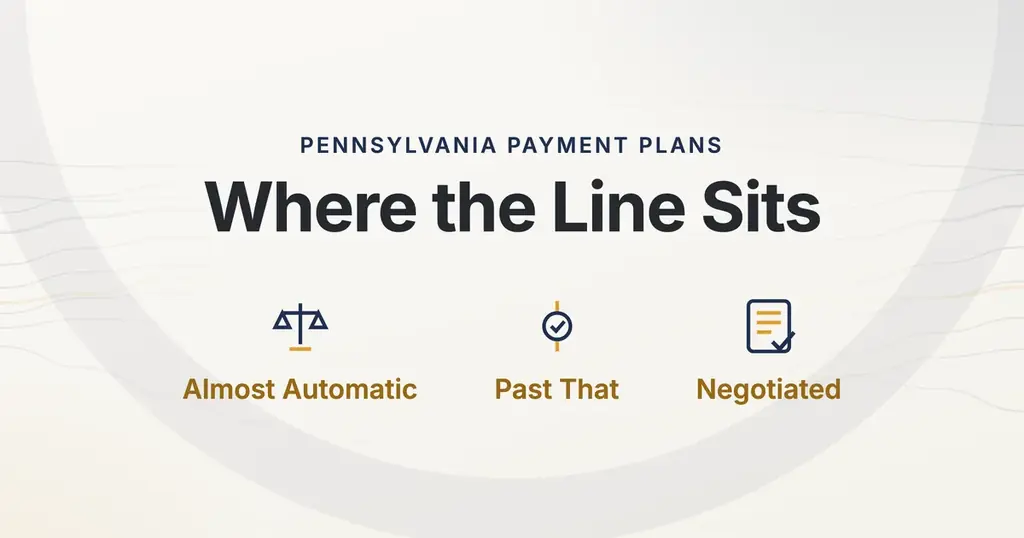
Pennsylvania is unusually clear about where its easy answer stops. The Department of Revenue publishes one threshold, and on the near side of it a payment plan is close to automatic. On the far side you are into financial disclosure and a negotiation. Knowing which side of that line you are on before you pick up the phone changes how the call goes. We work these from the Chadds Ford office, and this is the map.
Does Pennsylvania Grant Payment Plans?
Yes, and the Department separates them into two tracks. A standard plan covers a term of less than 12 months on a balance of less than $50,000, and you can set one up yourself through myPATH, by email or by phone. Anything longer, larger, or on top of an existing plan is an extended plan, which the Department handles through a different route.
What Revenue Approves Without a Fight
The threshold that decides everything
Under 12 months and under $50,000. The Department states both conditions on its personal income tax payment plans page, and inside them a plan is administrative rather than negotiated. If you are on the far side of either number, the call goes differently and preparation changes the result, which is where our Pennsylvania practice comes in. Before you set one up it wants all previous returns filed, and it asks that any balance not already in collections be pulled into the arrangement using form REV-638.
The three ways to ask
Online through myPATH is the fastest. Email or fax to the Department’s payment plan address works and wants your name, your Federal EIN, Revenue ID or Social Security number, mailing address, phone number and the number of months you want, with a reply expected inside two business days. Phone is the third option and wants your checking account and routing numbers ready before you call. Whichever route you pick, the number of months you request is a number you should choose deliberately, because it is the one term the Department lets you set.
Where It Gets Harder
Larger balances and financial disclosure
Past the threshold, the Department asks for a Statement of Financial Condition, REV-488 for individuals and REV-484 for businesses. That is a full picture of income, assets and expenses, and it is the point at which what you can afford stops being your assertion and becomes a document the Commonwealth evaluates. Prepare it the way you would prepare a federal collection information statement, because it will be read the same way.
Employer withholding and sales tax, which are treated differently
Money withheld from wages or collected from customers is not the business’s money and Pennsylvania does not treat it as an ordinary debt. Trust fund exposure reaches individuals personally, and the appeal deadlines are shorter than the ones that apply to personal income tax. If the balance you are trying to schedule is withholding or sales tax, the payment plan is not the first question to settle. Our collections defense practice starts with the exposure, not the schedule.
A plan already on file
Having a plan with the Department pushes you onto the extended track even if the new balance is small. In practice that means a second bad year turns a routine arrangement into a disclosure exercise, which is a good reason to deal with the first one properly.
Interest Keeps Running While the Plan Does
A payment plan is not a freeze. Pennsylvania charges simple interest calculated daily from the original due date to the date of payment, at an annual rate the Department announces for each year in form REV-1611 and divides by 365 to get the daily figure. Interest accrues for every day the balance is open, including the days you are paying on time under an approved plan. Sitting on top of that, the Department’s own guidance sets an underpayment penalty of 5 percent on the unpaid balance where a return was filed on time and the tax was not paid, and a separate late filing penalty of 5 percent of the tax due for each month the return is late up to 25 percent. That combination is what makes a long term expensive and a short one worth stretching for.
What to Do When Revenue Says No
Petitioning the board of appeals
The Board of Appeals hears petitions against assessments, the clock is short, and each tax runs on its own clock. Form REV-1799A sets the limits out. Personal income tax and employer withholding get 90 days from the assessment mailing date. Sales and use tax, corporation tax adjustments and responsible party assessments get 60 days. Miss the window and the assessment stands whatever its merits were.
Attacking the assessment rather than the terms
Most people arguing with the Department about a payment plan are actually arguing about the balance. If the figure came from an estimated assessment, an audit adjustment or a responsible party determination, the payment plan conversation is the wrong conversation and agreeing to terms concedes the number. Federal collection works the same way, which is the point we make in our piece on the IRS CP504 notice. New Jersey runs its own version of all of this, with a longer standard term and different fees, and we covered it earlier this month.
Call the Chadds Ford Office While You Still Have Options
We have been at this since 1991, we are headquartered in Chadds Ford, and Pennsylvania collections work sits alongside the federal practice rather than under it. Our Pennsylvania service areas list the counties we work in most.
Business filers should start with our Pennsylvania corporate net income tax resource, because a corporate balance and a personal one are collected on different tracks. Everything we do on the collection side is set out under our tax resolution services.
If Revenue has sent you an assessment you do not agree with, talk to a Pennsylvania tax attorney before the appeal window closes.
FAQ
Does PA have a payment plan for taxes?
It has two. A standard plan for terms under 12 months on balances under $50,000, which you can arrange yourself online, by email or by phone. An extended plan for anything longer, larger, or where a plan is already in place, which requires a Statement of Financial Condition and a decision by the Department.
How do I pay my PA state tax that I owe?
Payments go through myPATH, the Commonwealth’s online tax system, which is also where a standard payment plan is set up. If you are arranging a plan by phone or email instead, the Department will want your bank routing and account details to set up the schedule.
What if I can’t pay my taxes by April 15th?
File anyway. The filing obligation and the payment obligation are separate, and the late filing exposure is the worse of the two in most states. Pay what you can with the return, then arrange a plan for the rest. Interest runs on the unpaid balance from the original due date either way, so nothing is gained by holding the return back.
What is the PA tax forgiveness program?
Tax Forgiveness is a Pennsylvania credit for low income taxpayers, claimed on Schedule SP with the return, that can reduce or eliminate personal income tax liability depending on eligibility income and the number of dependents. It is a filing position on a return, not a settlement route for a balance you already owe, and the two get confused constantly.

About the Author
Gregory McCauley Jr., Esq.
Tax Attorney · Villanova University School of Law · Admitted in Delaware, New Jersey, United States Tax Court
Gregory McCauley Jr. is an experienced tax attorney who has personally represented more than 1,000 clients in matters ranging from civil tax controversy and IRS examinations to criminal tax defense, U.S. Tax Court litigation, and complex business disputes. His practice is built on a foundation his c...
Related IRS Resources