How to Refinance a Property the IRS Has a Lien On

The refinance was approved. Then the title search came back, and underwriting went quiet. A recorded Notice of Federal Tax Lien means the government’s claim sits ahead of any loan written after the filing date, and no lender will fund into second position on its own paper. This does not kill the refinance. It just means the IRS has to be asked, formally, to step behind the new lender.
What Lien Subordination Is
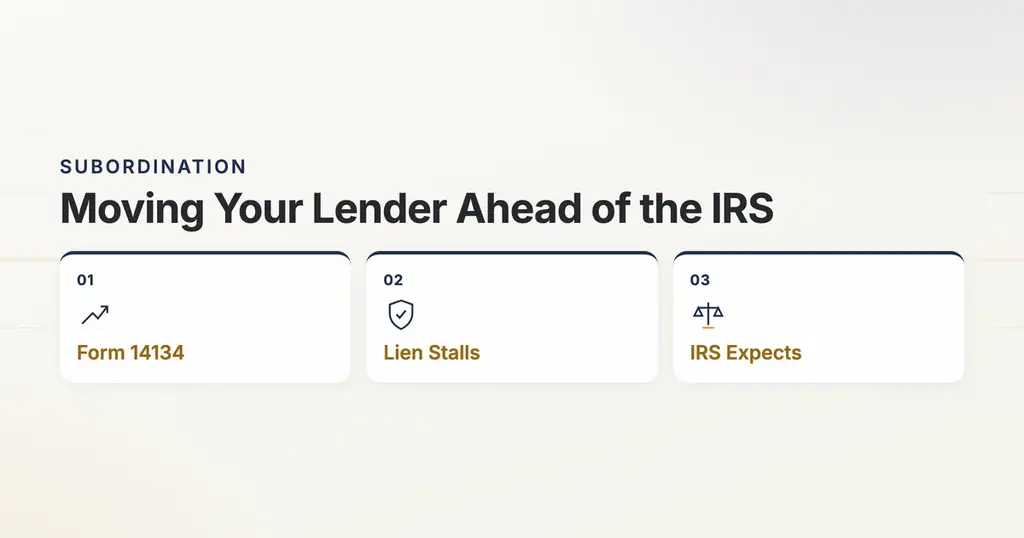
Subordination is the IRS agreeing that a named creditor may move ahead of the government’s position on a specific property. The lien stays on the property and the balance stays owed. Only the priority order changes. You apply on Form 14134 under Internal Revenue Code section 6325(d), and the IRS grants it when doing so gets it paid faster or gets it paid more.
Why a Refinance Stalls When There Is a Federal Tax Lien
What the lender sees in the title search
The lender does not see a tax problem. It sees a recorded claim with an earlier date than the mortgage it is about to write, which means that in a foreclosure the government gets paid first. Underwriting is not being difficult. It cannot write a first-position loan into second position, and no amount of explaining your case will change the recording dates.
Why paying the lien off first is usually not available
The obvious answer, clear the lien and then refinance, is circular for most borrowers. The money to pay the balance is the money the refinance was going to release. That circularity is the reason section 6325(d) exists, and it is also the argument that wins the application. You are not asking the IRS for a favor. You are showing it that moving behind the lender is how it gets paid.
How to Request Subordination
The two grounds under section 6325(d)
There are two, and they are answered very differently. Under section 6325(d)(1) you pay the IRS an amount equal to the interest it is subordinating, and the IRS grants the certificate in exchange for that payment. Under section 6325(d)(2) you pay nothing up front, and instead you show that granting the certificate will increase what the government ultimately collects and make collection easier. Refinancing to a lower rate so you can pay more each month is the textbook section 6325(d)(2) case, and Publication 784 uses a wholesaler restocking inventory to make the same point for a business.
Working through Form 14134
The form runs on the same discipline as the discharge application. It asks for the lien numbers, the property, the amount of new financing sought, the amount you propose to pay the government where that applies, and the basis you are relying on. Where you are applying under section 6325(d)(2), the IRS also wants a signed and dated statement describing how the subordination increases what it will realize and how it makes collection easier. That statement is the application. Everything else is supporting paper.
What your lender has to hand over
You will need the loan commitment or term sheet showing the new financing, an appraisal by a disinterested third party, a title report, the payoff figure on the existing loan, and the closing cost estimate. The section 6325(d)(1) calculation runs directly off those numbers. The worked example in Publication 784 takes the new loan amount, subtracts the payoff on the existing loan and the cost of obtaining the new one, and treats what is left as the equity the refinance releases. That figure is what the IRS asks to be paid in exchange for stepping behind the lender, and it is usually far smaller than the balance owed.
Why the 45 day window drives your closing date
Publication 784 asks for the application at least 45 days before the transaction date the certificate is needed for. Rate locks are frequently shorter than that. If the lock and the IRS review window are in conflict, raise it with the lender at term sheet stage, not the week of closing.
Subordination Is Not Discharge and Not Withdrawal
Three remedies, three different situations, three different forms. Subordination reorders priority and suits a refinance. Discharge lifts the lien off one property and suits a sale, which is the companion post we published at the start of this month. Withdrawal pulls the public notice off the record, and we set that out in our post on Form 12277. The IRS’s own eligibility rules for a Fresh Start withdrawal require a direct debit installment agreement and a balance of $25,000 or less, which is a threshold subordination has no equivalent of. All three, with the code sections behind them, sit on our tax lien discharge and release service page.
If the IRS Refuses
Advisory states its reason. Where the refusal turns on valuation, a better appraisal or a corrected payoff figure often resolves it, because the disagreement is factual. Where the refusal is a section 6325(d)(2) determination that collection is not actually improved, the answer is a stronger written statement showing the arithmetic, not an appeal on principle. And if the refinance was the plan for resolving the balance, refusal means it is time to look at the collection alternatives instead, which is the ground our tax resolution services cover.
Send Us the Term Sheet While It Is Still a Draft
The best moment to bring us in is when the loan terms are still moving, because the numbers in the term sheet are the numbers the IRS will run its test on, and small changes to loan amount and closing costs change the answer. We prepare these applications, we deal with Advisory directly, and we have gotten liens repositioned against real closing dates, as our case results show. Outcomes turn on the facts of each matter.
If a lien is holding up your refinance, speak to a tax attorney about the loan terms.
FAQ
What is lien subordination?
It is a written IRS agreement that a specified creditor may take priority over the federal tax lien on a named property. The lien is not removed and the debt is not reduced. It is a change in the order of claims, granted under section 6325(d) when it helps the government collect.
How can I get an IRS lien removed?
Removal depends on what you mean. A release happens when the liability is paid or becomes legally unenforceable. A discharge takes the lien off one property. A withdrawal removes the public notice while the debt may remain. Subordination removes nothing. Our guide to lien remedies sets out which applies when.
At what amount does the IRS put a lien?
There is no statutory dollar threshold. Under section 6321 the lien arises by operation of law once tax is assessed, notice and demand is made, and the taxpayer does not pay. Whether the IRS then files a public Notice of Federal Tax Lien is an administrative decision governed by internal guidance that changes, so a figure you read online is not a rule you can rely on.
How serious is an IRS tax lien?
Serious enough that it attaches to everything you own and everything you acquire while it is in force, and public enough that lenders, title companies and business counterparties see it. It also runs for as long as the collection period does, which is the subject of our post on the federal tax lien statute of limitations.

About the Author
Gregory McCauley Jr., Esq.
Tax Attorney · Villanova University School of Law · Admitted in Delaware, New Jersey, United States Tax Court
Gregory McCauley Jr. is an experienced tax attorney who has personally represented more than 1,000 clients in matters ranging from civil tax controversy and IRS examinations to criminal tax defense, U.S. Tax Court litigation, and complex business disputes. His practice is built on a foundation his c...