The Tax Evasion Statute of Limitations Does Not Always Start When You File (A Later Act Can Move It)

You are generally exposed to a federal tax evasion charge for six years. That period runs from the later of the return’s due date or the last affirmative act of evasion, not simply from the day a return was filed. A false statement to an agent years later can move that start date forward, so an old return isn’t automatically out of reach.
If you left income off returns in past years and you’re wondering whether prosecution is still possible, the answer depends on dates only a lawyer should work through with you, privately. Our criminal tax defense practice starts with that timeline.
What Is the IRS’s Six-Year Rule?
The six-year rule is the criminal limitations period for most serious tax crimes. Section 6531 of the Internal Revenue Code sets a general three-year period for offenses under the tax laws and then lists the ones that get six years instead. Willfully attempting to evade a tax is on that list. So are defrauding the United States, willfully failing to file or pay, filing a false return under section 7206(1), and conspiring to evade.
In practice that means nearly every charge a taxpayer worries about carries the longer period. The three-year period is left for a narrower set of offenses.
Where the Clock Starts
The start date is where most people’s assumptions go wrong. The Justice Department’s Criminal Tax Manual chapter on limitations states the general rule plainly. For evasion, the period begins on the date of the last affirmative act of evasion or the return’s statutory due date, whichever is later.
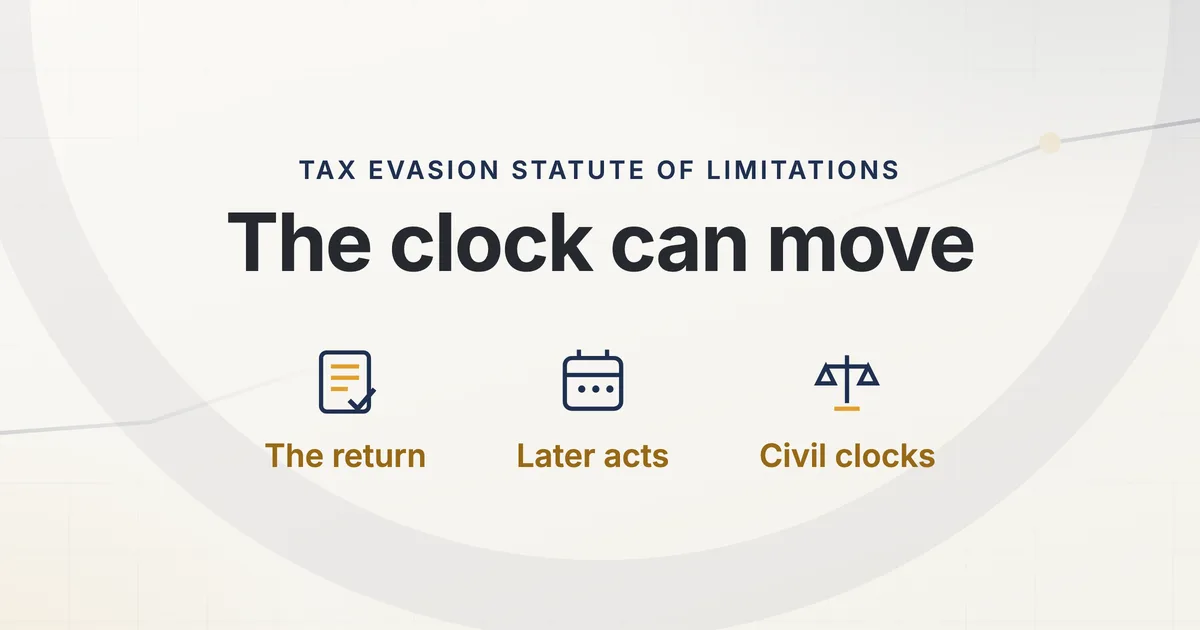
The Return Itself
When the only act of evasion is filing a false return, the clock starts on the filing date or the due date, whichever comes later. An early filer doesn’t gain anything by filing in February. A late filer starts the clock on the day the return actually went in.
When no return is filed at all, the same later-of rule applies to whatever act of evasion took place. The manual’s example is a false Form W-4 filed in June 2000 for a year whose return was due in April 2001 and never filed. Because the due date came later, the six years ran from April 2001, not from the date of the false form.
Later Acts of Evasion That Move the Start Date
Evasion isn’t limited to the return. The Supreme Court described it in Spies as any conduct likely to mislead or conceal, and the manual’s own example shows what that does to the timeline. A false return filed on time in April 2001 would ordinarily start the clock then, but if the taxpayer lied to IRS agents about that year in September 2002, the six years ran from September 2002.
That’s why our income tax evasion page describes the period as six years from the last affirmative act. Hiding assets, moving money through nominees and misleading an examiner can all count, and each one can carry the deadline further out.
What Pauses It
Section 6531 stops the count while the person is outside the United States or is a fugitive from justice, so years spent abroad don’t use up the period. The statute also extends it when a complaint is filed before a magistrate within the period, pushing the deadline to nine months after the complaint.
The manual covers further suspensions tied to summons enforcement proceedings and official requests for evidence held overseas. Anyone with foreign accounts or records outside the country should assume the calendar is longer than six years until someone has checked.
What Qualifies as Evasion Rather Than a Mistake
What qualifies as tax evasion is a willful attempt to evade or defeat a tax, plus an affirmative act to carry it out. A math error, a missed form or a position taken in good faith isn’t evasion. Simply failing to file or pay isn’t either, and our evasion page makes the same point, because the government has to show you actively tried to conceal or deceive. Willfulness is where many of these cases are fought, and our hub page notes that evasion carries up to five years per count.
Filing a return you know is false is a separate felony under section 7206(1), and it can be charged whether or not any tax was owed. Our page on filing a false tax return covers that charge.
How Often Evasion Cases End in Prison
Prison is the usual result once a case reaches sentencing. IRS Criminal Investigation’s 2025 annual report puts its conviction rate at 89%, and across every case it saw sentenced in fiscal year 2025, the incarceration rate was 76%, with an average of 49 months to serve.
Those figures cover all of the agency’s cases, not only tax evasion, and no statistic predicts a single matter. They do show why the decisions made before any charge is filed carry so much weight.
The Civil Clocks That Keep Running After the Criminal One Ends
When the criminal period expires, the civil exposure doesn’t. Under section 6501, the IRS generally has three years after a return is filed to assess more tax, and six years when the return leaves out more than 25 percent of the gross income it reports. For a false or fraudulent return filed with intent to evade, the tax can be assessed at any time.
Once tax is assessed, a separate collection period applies, which we explain in our post on the separate 10-year collection clock. A lapsed criminal deadline doesn’t close either civil door.
Speaking With Counsel Before Anyone Speaks With an Agent
If a Special Agent contacts you, your spouse, your accountant or your employees, say nothing beyond your name and that you want a lawyer, then call us. What you tell our attorneys is protected by attorney-client privilege, and what you tell an agent can become the affirmative act that moves your deadline.
Gregory McCauley Jr., who defends IRS-CI investigations, handles these calls with our criminal tax team. If you’re worried about an old return or an agent has already reached out, contact us before you respond to anyone.
FAQ
How common is it to go to jail for tax evasion?
Common once a case is sentenced. IRS Criminal Investigation reported a 76% incarceration rate across the cases it saw sentenced in fiscal year 2025, with an average of 49 months to serve. The figure covers all of its cases, so it’s a guide rather than a prediction.
What is the IRS’s 6 year rule?
In criminal cases, it’s the six-year limitations period in section 6531 of the tax code for evasion, false returns, willful failure to file or pay, and fraud against the United States. In civil cases, section 6501 also gives the IRS six years to assess tax when a return omits more than 25 percent of the gross income reported.
What is the IRS 3 year rule?
It’s the general civil deadline. The IRS usually has three years after a return is filed to assess additional tax. The deadline doesn’t apply to a fraudulent return, which can be assessed at any time, and a longer six-year period applies to large income omissions.
What qualifies as tax evasion?
A willful attempt to evade or defeat a tax combined with an affirmative act, such as filing a false return, hiding income or assets, or lying to investigators. Honest mistakes and simply failing to file or pay don’t qualify on their own.

About the Author
Gregory McCauley Jr., Esq.
Tax Attorney · Villanova University School of Law · Admitted in Delaware, New Jersey, United States Tax Court
Gregory McCauley Jr. is an experienced tax attorney who has personally represented more than 1,000 clients in matters ranging from civil tax controversy and IRS examinations to criminal tax defense, U.S. Tax Court litigation, and complex business disputes. His practice is built on a foundation his c...
Related IRS Resources