Why the IRS Restricts Passport Renewals for Delinquent Taxpayers – And How to Check Your Status


Traveling abroad should be about adventure and relaxation, not anxiety over tax troubles. At McCauley Law Offices, P.C., we’ve seen how IRS certifications can derail plans by linking tax debts to passport restrictions. This post explores why the IRS imposes these rules, the practical impacts, and how to determine if you’re affected.
The IRS’s Rationale for Passport Restrictions
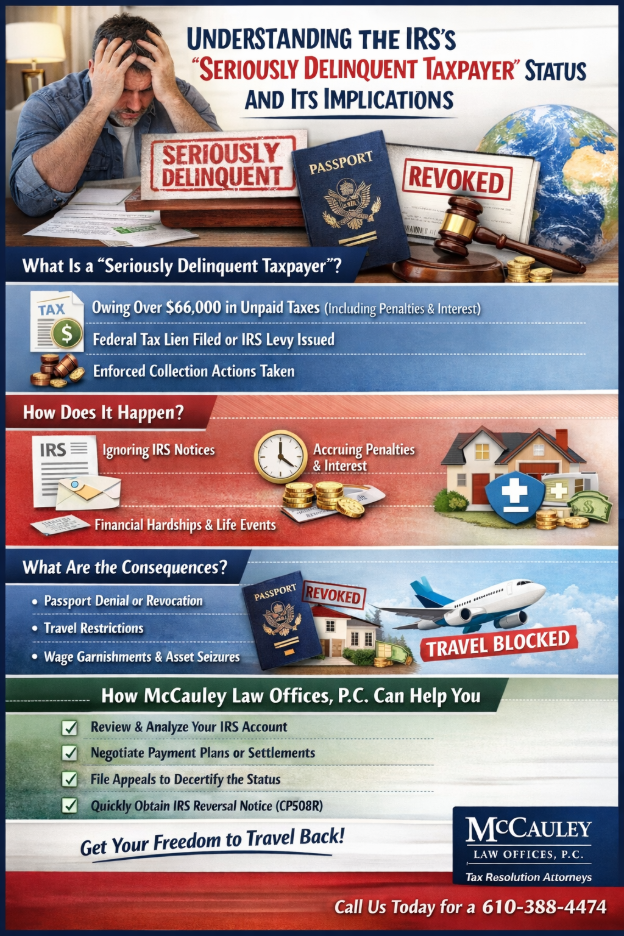
Enacted through the Fixing America’s Surface Transportation (FAST) Act in 2015, this policy aims to encourage compliance with tax obligations. By certifying seriously delinquent tax debts (over $66,000 in unpaid federal taxes, penalties, and interest) to the State Department, the IRS uses passport denial as a collection tool. The goal is to motivate taxpayers to resolve debts, as international travel is a privilege tied to fulfilling civic duties like paying taxes. Since implementation, the IRS has collected over $1.2 billion through this program, demonstrating its effectiveness.
What It Means in Practice
If You Have a Valid Passport: Certification doesn’t automatically invalidate your current passport for immediate use, but the State Department may revoke it, especially if you’re applying for renewal or if the debt remains unresolved. Revocation can occur without warning, potentially stranding you abroad or preventing future trips.
If You Don’t Have a Passport or It’s Expired: The State Department will deny new applications or renewals outright upon receiving IRS certification. This blocks you from obtaining travel documents until the debt is addressed.
In either case, the restriction emphasizes the debt’s severity, connecting financial accountability to mobility rights.
The Connection to Seriously Delinquent Status
This passport issue stems directly from the “seriously delinquent” certification. Once the IRS exhausts collection efforts (e.g., liens or levies), it sends notice CP508C to you and certifies the debt. The State Department then acts, holding applications for 90 days to allow resolution. Exceptions exist, like debts under appeal, in installment agreements, or qualifying for humanitarian exemptions (e.g., urgent family emergencies abroad).
How to Know If Your Passport Is Affected
- Check IRS Notices: Look for CP508C, which explicitly states certification and warns of passport implications.
- Apply for Renewal: If denied, the State Department will notify you of the hold, giving 90 days to fix it.
- Contact the IRS: Use your online IRS account or call to verify your debt status and certification.
- State Department Inquiry: If planning travel, check your passport application status or consult their website for tax-related holds.
If you suspect an issue, act quickly. McCauley Law Offices, P.C. can help verify your status and guide you through resolution.

About the Author
Gregory McCauley Jr., Esq.
Tax Attorney · Villanova University School of Law · Admitted in Delaware, New Jersey, United States Tax Court
Gregory McCauley Jr. is an experienced tax attorney who has personally represented more than 1,000 clients in matters ranging from civil tax controversy and IRS examinations to criminal tax defense, U.S. Tax Court litigation, and complex business disputes. His practice is built on a foundation his c...
Related IRS Resources