IRS Form 843, How to File It and When Form 433-D Is the Right Form Instead

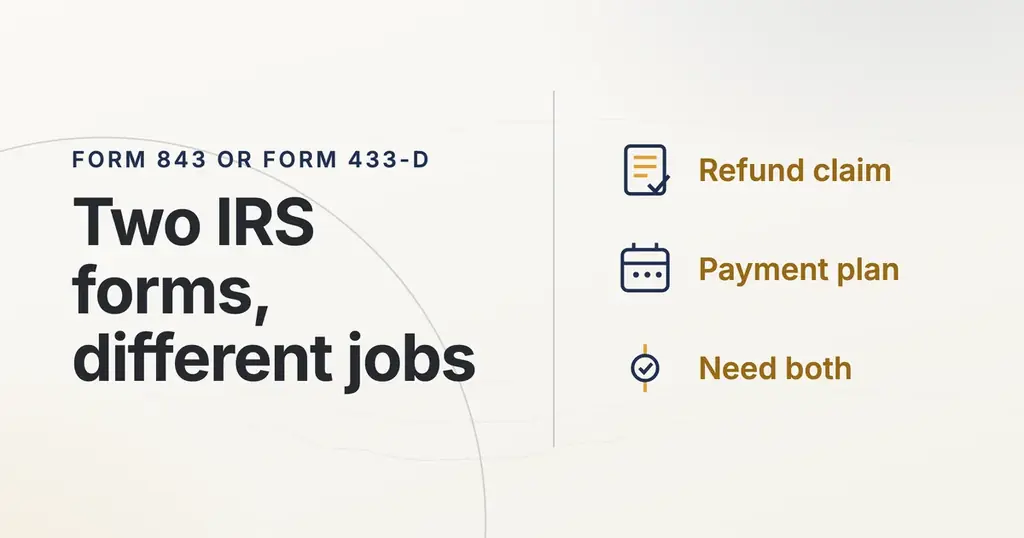
Every year we open files where the taxpayer already mailed the IRS a form, and it was the wrong one. Form 843 and Form 433-D turn up in the same searches and get confused constantly, but they do opposite jobs. One asks the IRS to give something back. The other tells the IRS what you can afford to pay. Mailing the wrong one does not just waste a stamp. It burns weeks while penalties keep running. Below is what Form 843 actually asks for, what has to go in the envelope with it, and how to tell which of the two forms your situation calls for.
What IRS Form 843 Is For
Form 843 is titled Claim for Refund and Request for Abatement. You use it to ask the IRS to refund something you already paid or to knock an amount off an assessment that is sitting on your account. The most common uses are a request to abate a penalty, a request to abate interest that accrued because of an IRS error or delay, a refund of certain taxes or fees that were assessed incorrectly, and a request tied to a reduced assessment after an examination.
There are things Form 843 does not do, and this is where most of the wasted filings happen. It is not the form for a refund of income tax you overpaid on a return, and it is not the form for setting up a payment arrangement. It also does not stop collection on its own. If the IRS is actively levying while your claim sits in a processing queue, that is a separate problem and it needs a separate filing.
What Form 843 Actually Asks You For
The form itself is short. That is deceptive, because the IRS decides these claims almost entirely on the attachment, not on the boxes.
The tax period and the type of tax
You identify the exact period the claim covers and the type of tax, penalty, or fee at issue. Vague period entries are one of the fastest ways to get a claim bounced back, because the IRS matches your entry against a specific module on your account. If you owe for several years, one form per period is the safer approach.
The amount and the reason
You state the dollar amount you want refunded or abated and you identify why. The form gives you a short set of reasons to choose from and then a space to explain. The explanation space is small on purpose. Nobody is expected to fit a real argument in it, which is why the instructions on IRS.gov tell you to attach additional pages.
What to attach
This is the part that decides the outcome. A claim that arrives with the notice you received, the account transcript for the period, proof of the payment or the dates involved, and a written statement laying out the facts in order gets read on its merits. A claim that arrives with a single paragraph and no documents gets a form letter back. If your argument depends on something the IRS did, such as a delayed response or written advice you relied on, the correspondence itself belongs in the envelope.
Where to Send Form 843 and What Happens Next
There is no single address. The current Form 843 instructions on IRS.gov route the claim based on why you are filing and what notice prompted it. Some claims go to the service center where you filed the underlying return. Others go to the address printed on the notice you received. If the claim relates to an examination, it may belong with the office that made the assessment. Check the instructions for your specific reason rather than reusing an address from an older filing, because these routing rules change.
After it is filed, expect a wait, then a written determination. If the IRS denies the claim, that denial is not the end of the road. A denied refund or abatement claim can be taken further, and talk to us about IRS Appeals if that is where your case has landed, because the deadlines that attach to a denial are short and unforgiving.
What IRS Form 433-D Is For
Form 433-D sits on the collection side of the house. It is the installment agreement form, the document that records the terms of a payment arrangement with the IRS, including the monthly amount, the payment method, and the direct debit authorization. It is not an argument about whether you owe. It is the paperwork that formalizes how you will pay what has already been assessed.
We wrote about that form in detail already, so we will not repeat it here. Read our breakdown of Form 433-D if the payment side is where your case actually sits, and see the Form 433-D instructions in our resource library for the field by field walkthrough.
One more source of confusion is worth clearing up while we are here. Form 433-D is not the same thing as Form 433-A or Form 433-F, which are the collection information statements the IRS uses to work out what you can pay in the first place. Our guide to the Form 433 series sorts out which is which.
Form 843 vs Form 433-D, the Real Difference
Refund or abatement requests
Form 843 is a claim. You are telling the IRS that an amount on your account should not be there, or that money you already paid should come back. The burden is on you to show why, and the attachment carries that burden.
Collection financial statement
Form 433-D is an agreement. You are not disputing the balance. You are proposing terms and asking the IRS to accept them. Nothing about it reduces the underlying liability.
When you may need both
Plenty of real cases need both, in sequence. A taxpayer with a large assessment might file Form 843 to strip the penalty portion off the balance while at the same time entering an installment agreement on Form 433-D so that collection stays quiet during the wait. Running them in the wrong order is where people lose leverage, and it is one of the things worth thinking through before anything gets mailed.
How to Decide Which Form You Need
Ask yourself one question first. Are you arguing that the number on your account is wrong, or are you accepting the number and dealing with how to pay it? If it is the first, you are in Form 843 territory. If it is the second, you are in Form 433-D territory. If your honest answer is both, the sequence matters and the timing matters more.
When to Get a Tax Attorney Involved
A single penalty on a single year with clean documentation is a filing most people can handle. It stops being that when the assessment came out of an examination, when several years are in play, when the IRS has already started collecting, or when a denial letter has arrived and a clock is running. Those are the cases we take, and browse our tax resolution services to see how they get handled. We work out of Chadds Ford, Haddonfield, and Westminster, and we represent taxpayers nationwide in federal tax matters.
FAQ
What is the IRS form 843 used for?
It is used to claim a refund of certain taxes, penalties, fees, or interest, or to ask the IRS to abate an amount that has been assessed. Common uses include penalty abatement requests and interest caused by an IRS error or delay. It is not used for a refund of overpaid income tax reported on a return.
How long does it take for the IRS to respond to form 843?
Longer than most people expect. These claims are worked by hand and processing times move with IRS workload, so plan on months rather than weeks. If collection activity is running while you wait, that has to be handled separately, because filing the claim does not pause it.
How do you know if you’re eligible for form 843?
Eligibility comes down to what you are asking for. The form covers specific categories of refunds and abatements, and the current instructions on IRS.gov list them. If the amount you want back is an income tax overpayment reported on a return, Form 843 is the wrong vehicle. If it is a penalty, an assessed fee, or interest tied to an IRS delay, it is likely the right one.
Not sure whether Form 843 or Form 433-D applies to your case? We identify the right filing in a free consultation. Talk to a tax attorney before anything goes in the mail.

About the Author
Daniel S. Heller, Esq.
Tax Attorney · University of Pennsylvania · Admitted in U.S. Court of Appeals for the Fourth Circuit, U.S. District Court for the District of Maryland, U.S. District Court for the Eastern District of Pennsylvania
Daniel S. Heller is a senior tax attorney at McCauley Law Offices, where he represents individuals and businesses in high-stakes disputes with the Internal Revenue Service and state taxing authorities. His practice spans the full life cycle of a federal tax matter — from audit defense and administra...
Related IRS Resources