Delaware Franchise Tax Nonpayment, Void Status and How Reinstatement Works

The call usually comes mid deal. A buyer’s counsel runs a good standing check on a Delaware entity and the certificate does not come back clean. Sometimes the client had no idea, because the registered agent notices went to an address nobody checks anymore. Delaware is the incorporation capital of the country and a very large number of businesses that operate nowhere near Wilmington are Delaware entities on paper. That paper obligation does not go away because the business moved, shrank, or stopped filing.
What Delaware Franchise Tax Is and Who Has to Pay It
Delaware franchise tax is not a tax on income or on profit. It is an annual charge for the privilege of existing as a Delaware entity, and it is owed whether the company made money, lost money, or did nothing at all. Corporations formed in Delaware owe it along with an annual report. Limited liability companies, limited partnerships, and general partnerships formed in Delaware owe an annual tax as well, without the annual report requirement that applies to corporations.
The obligation attaches to formation, not to activity. An entity that has been dormant for five years still owes for each of those five years. Our Delaware franchise tax resource page covers the filing calendar and who files what.
There is a second obligation riding alongside it that owners forget even more often. Every Delaware entity must maintain a registered agent in the state, and the agent charges an annual fee that is separate from the tax. When that fee goes unpaid the agent resigns, notices stop reaching anyone, and the company loses its early warning system at exactly the moment it needs one. A large share of the void charters we untangle started with a registered agent resignation and an address nobody updated after a move.
What Happens If You Do Not Pay Delaware Franchise Tax
Nothing dramatic happens on day one, which is part of why this problem grows quietly. Penalty and interest attach to the unpaid amount. Notices go to the registered agent. If the balance sits long enough, the entity stops being in good standing, and eventually the charter is voided by the state.
The consequences of that show up somewhere other than the tax bill. A voided entity cannot get a certificate of good standing, which means financing stalls, deals stall, and in some cases the ability to bring or defend a lawsuit in Delaware is affected.
The knock on effects reach further than most owners expect. Banks ask for a good standing certificate before closing a loan or opening certain accounts. Buyers and investors ask for one in diligence. Landlords, licensing boards, and prime contractors ask for one. None of those parties care why the entity is out of standing, and none of them will wait the several weeks a cure can take. That is the actual cost of a delinquency that looked like a small annual bill.
There is also a personal exposure question worth raising early. Owners occasionally continue signing contracts on behalf of a company whose charter was forfeited, and the question of who is bound by those agreements is not one you want a counterparty raising first.
Void vs Voidable, the Good Standing Trap
Delaware distinguishes between an entity that has fallen out of good standing and one whose charter has actually been voided. In the first state, the company still exists but cannot get a clean certificate. In the second, the charter has been forfeited by the state for continued nonpayment.
The trap is that owners often discover the difference at the worst possible moment. A company that thinks it is merely behind on a bill learns during due diligence that its charter was voided years ago, and that every contract signed since then now has a question mark over it. Delaware provides a path back, and actions taken during the void period are generally validated once the entity is restored, but that restoration has to actually happen and it takes time nobody has budgeted for.
How the Penalty and Interest Build
Delaware charges a penalty for failing to file or pay by the statutory deadline, and interest accrues monthly on the unpaid balance until it is cleared. The Delaware Division of Corporations publishes the current penalty and interest figures, and those are the numbers to work from rather than anything quoted secondhand.
The important structural point is that this compounds across years. Each unpaid year carries its own tax, its own penalty, and its own accruing interest. A three year lapse is not three times the annual bill, it is meaningfully more, and that arithmetic is what turns a routine oversight into a number that stops a transaction.
Reinstating a Voided Delaware Entity
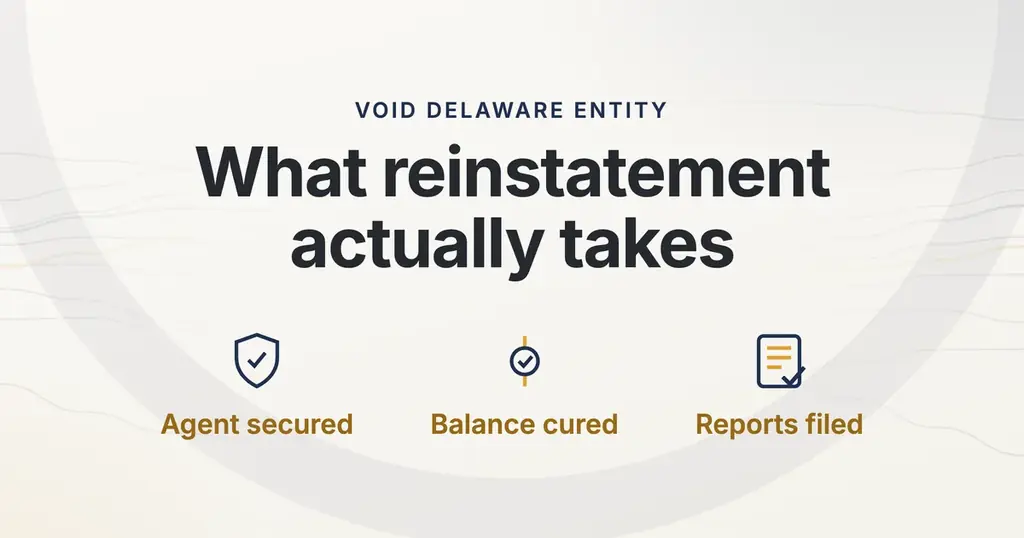
Reinstatement runs through the Delaware Division of Corporations. In broad terms it means filing a certificate of renewal or revival, bringing every delinquent year current including tax, penalty, and interest, filing whatever annual reports were missed, and having a registered agent in place who will accept the filing.
Order matters. A registered agent has to be secured before the reinstatement filing can be accepted, and the Division will not process a partial cure. Once it goes through, the entity is restored and the certificate of good standing becomes available again. If your business is in Delaware and you want counsel who works there, we have offices and attorneys covering the state, and our pages for a tax attorney in Wilmington and a tax attorney in Dover explain how we work with Delaware entities.
How Much Delaware Franchise Tax an LLC Owes
Delaware limited liability companies pay a flat annual tax rather than a calculated one. The amount is set by statute and published by the Division of Corporations, and it does not vary with revenue, assets, or member count. That flat structure is why LLC delinquencies are usually a filing failure rather than a cash flow failure.
Corporations are different, and this is where the sticker shock lives. Delaware corporations can compute the tax under the authorized shares method or the assumed par value capital method, and the two can produce wildly different results for the same company. A startup that authorized a very large number of shares and never revisited it can receive a bill under the default method that bears no relation to the size of the business. Recomputing under the alternative method is often the fix, and it is one of the mistakes we see most often. Our post on 7 mistakes with Delaware franchise tax covers the rest of that list.
Resolving the Underlying Debt
Reinstating the entity clears the state’s records. It does not by itself resolve what the business owes, and it rarely arrives alone. A company that stopped paying Delaware franchise tax has usually stopped paying something else too, and by the time we are called there is often a federal payroll or income tax problem sitting behind the state one. Working those in isolation wastes money, because the negotiating posture on one affects the other. See how we handle tax resolution when both are live.
FAQ
What is the franchise tax in Delaware?
It is an annual tax owed by entities formed in Delaware for the privilege of existing under Delaware law. It is not based on income or profit. Corporations owe it alongside an annual report, and LLCs and partnerships owe an annual tax without the report.
Who must pay Delaware franchise tax?
Every domestic Delaware corporation, limited liability company, limited partnership, and general partnership, whether or not it conducted any business during the year. The obligation attaches to being formed in Delaware, not to operating there.
How much is Delaware franchise tax for LLC?
Delaware LLCs pay a flat annual amount set by statute rather than a calculated figure, and the Division of Corporations publishes the current amount. It does not change with revenue or membership.
How to compute Delaware franchise tax?
Corporations may use the authorized shares method or the assumed par value capital method, and the two can produce very different results for the same company. LLCs pay the flat statutory amount. Always compute both methods before paying a corporate bill.
Delaware entity lost good standing? We reinstate voided Delaware franchises and resolve the tax debt sitting behind them. Request a free consultation and we will price the cure before you commit to it.

About the Author
LaTanya Johnson, EA
Enrolled Agent · Admitted in Enrolled Agent — authorized to represent taxpayers before the IRS and state departments of revenue
LaTanya Johnson is an Enrolled Agent at McCauley Law Offices, authorized to represent taxpayers before the Internal Revenue Service and state departments of revenue at every level of examination, collection, and appeal. The Enrolled Agent credential is earned by passing a rigorous three-part IRS exa...