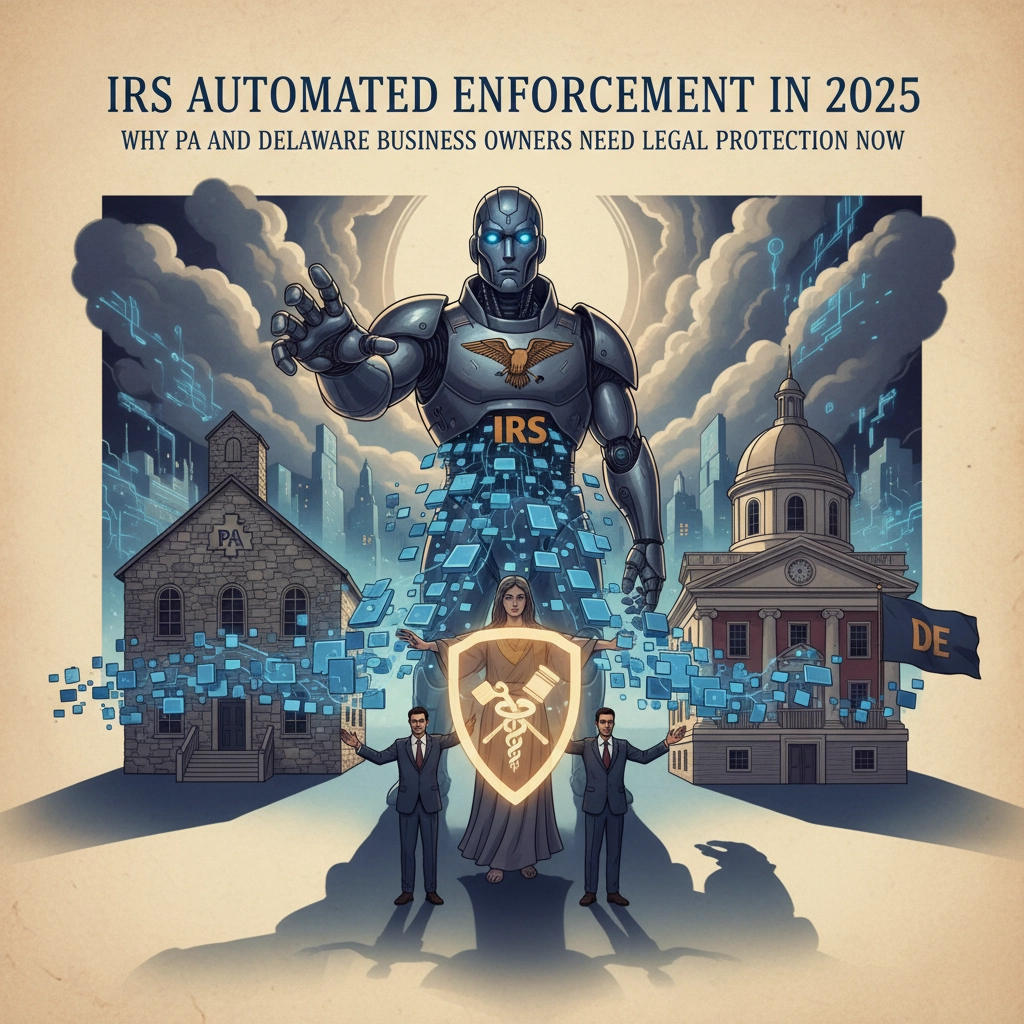
If you're a business owner in Pennsylvania or Delaware, 2025 just became a whole lot more complicated. While you were focused on running your business, both the IRS and your state governments were busy implementing sweeping changes that could put your company directly in the crosshairs of automated enforcement actions.
Here's the reality: The IRS isn't just getting tougher: it's getting smarter. And your state is demanding more paperwork than ever before. Together, these changes create a perfect storm of compliance risks that could trigger audits, penalties, and legal headaches faster than you can say "artificial intelligence."
The IRS Just Got Scary Smart (And Lightning Fast)
Gone are the days when you could fly under the radar with sloppy bookkeeping or "creative" deductions. The IRS has unleashed AI-powered enforcement systems that make their old audit selection process look like searching through filing cabinets with a flashlight.

Here's what these new systems can do that should keep you awake at night:
Real-Time Pattern Recognition: The IRS AI doesn't wait for tax season to start looking at your returns. It's scanning your financial patterns year-round, comparing your reported income against your spending patterns: including what you post on social media. That new company truck you posted on Instagram? The system noticed, and it's wondering how a business reporting $50K in profit can afford a $70K vehicle.
Behavioral Anomaly Detection: The system creates a digital fingerprint of your business behavior, then flags anything that doesn't match the pattern. If you usually claim $5K in business meals and suddenly jump to $15K, you're getting flagged. If your cash deposits don't match your reported sales, you're getting flagged. If your business expenses seem inconsistent with your industry peers, you're definitely getting flagged.
Predictive Risk Scoring: Every tax return now gets an automated risk score based on hundreds of data points. High-risk industries (looking at you, restaurants and construction companies) get extra scrutiny. The algorithm learns from every audit, getting better at spotting red flags with each passing month.
The scariest part? This all happens automatically, and it happens fast. What used to take months of manual review now happens in days: sometimes hours. By the time you realize you're being audited, the IRS has already built a comprehensive case using data you didn't even know they had access to.
Pennsylvania Just Made Your Life More Complicated
Starting January 1, 2025, Pennsylvania decided that all the paperwork you're already filing wasn't enough. Now every business in the state must file annual reports with the Department of State: no exceptions.
This isn't just another form to forget about. It's another data source the IRS can cross-reference against your federal returns. When Pennsylvania knows your business structure, revenue estimates, and operational details, and the IRS has AI systems designed to spot inconsistencies, any mismatch between your state and federal filings becomes a potential audit trigger.
The bottom line: Pennsylvania just gave the IRS another way to catch you if your paperwork doesn't line up perfectly.
Delaware Businesses Got Hit Even Harder
If your business is incorporated in Delaware or operates there, August 1, 2025, changed everything. Delaware implemented the most comprehensive business law overhaul in years, and these changes don't just create more paperwork: they eliminate strategies businesses have used for decades to stay compliant cost-effectively.

No More Virtual Registered Agents: Delaware banned virtual offices for registered agents. If your registered agent was operating through a virtual office or mail forwarding service, that's now illegal. You need a physical presence, which means higher costs and more complexity. For businesses that were trying to maintain Delaware incorporation while minimizing physical presence, this creates immediate compliance issues.
Your Company Address Can't Be Your Agent's Address: Even if your corporation acts as its own registered agent, you can't use your registered agent's address as your principal place of business. This seemingly technical change forces many businesses to restructure their basic corporate setup.
Pay All Taxes Before Canceling: Delaware LLCs must now pay all annual taxes for the entire year before filing a Certificate of Cancellation. Previously, you had more flexibility with timing. This creates cash flow challenges and eliminates a cost-saving strategy many businesses relied on.
No More Franchise Tax Relief: Delaware eliminated the ability to reduce franchise tax penalties through certificates of correction or validation. If you owe back taxes, you're paying full freight: no relief mechanisms available.
More Required Disclosures: Delaware corporations must now disclose the nature of their business on franchise tax reports and comply with March 1st filing deadlines regardless of activity level. More disclosure means less privacy and more data for the IRS to analyze.
Why These Changes Create a Perfect Storm
Here's where things get really dangerous for business owners: these federal and state changes aren't happening in isolation: they're compounding each other.

The IRS AI systems are designed to cross-reference data from multiple sources. When Pennsylvania requires detailed annual reports and Delaware demands more business disclosures, you're providing more data points for the AI to analyze. Any inconsistency between your state filings and federal returns becomes a red flag.
Consider this scenario: Your Delaware annual report shows your business nature as "consulting services," but your federal return shows significant equipment purchases typical of a manufacturing business. The AI flags this immediately. Your Pennsylvania annual report estimates annual revenue at $500K, but your federal return shows $300K in reported income. Another flag. Your registered agent change due to Delaware's new virtual office ban shows up in state records, but you didn't update your business address on federal forms. Yet another flag.
Each flag feeds into your automated risk score, and once that score hits a certain threshold, you're getting audited: automatically.
The Enforcement Paradox That's Making Things Worse
Here's what makes 2025 particularly dangerous: The IRS has fewer human agents than ever, but enforcement is actually increasing. How is that possible? Automation.
The IRS is using technology to do what hundreds of human auditors used to do manually. The AI doesn't get tired, doesn't take lunch breaks, and doesn't overlook details. It processes thousands of returns per hour, flagging discrepancies that human auditors might miss.
But here's the problem: when you get flagged by an automated system, you're not dealing with a human auditor who might understand the context of your business decisions. You're dealing with a computer that only sees data points and statistical anomalies.

Why You Need Legal Protection Now, Not Later
If you're thinking you can handle this complexity on your own, you're making a dangerous assumption. The convergence of IRS AI enforcement and new state requirements creates legal challenges that go far beyond traditional tax preparation.
Documentation Standards Have Changed: The IRS AI systems expect perfect consistency across all filings. A small discrepancy that wouldn't have triggered human attention now generates an automatic flag. You need documentation systems designed to anticipate AI pattern recognition, not just satisfy traditional tax requirements.
Response Times Are Accelerated: When the AI flags your return, you have less time to respond than in traditional audits. The system generates audit letters automatically, and effective responses require understanding how the AI reached its conclusions: specialized knowledge most business owners don't possess.
State and Federal Coordination: With both Pennsylvania and Delaware requiring more detailed business information, you need strategies that ensure consistency across all jurisdictions. A mistake in one filing can cascade across all others, multiplying your audit risk.
Relief Mechanisms Are Disappearing: Delaware eliminated traditional penalty relief options, and IRS automation reduces opportunities for human judgment calls. Once you're in the enforcement pipeline, your options for negotiating or explaining circumstances are severely limited.
The Bottom Line for PA and Delaware Business Owners
2025 isn't just another year: it's the year business compliance became a high-stakes game where the house has artificial intelligence and you're playing with incomplete information.

The businesses that survive this transition will be those that recognize the new reality early and adapt accordingly. That means professional legal guidance that understands both the technology behind IRS enforcement and the specific compliance requirements affecting Pennsylvania and Delaware businesses.
Don't wait until you're facing an automated audit notice to realize you needed help. By then, the AI has already built its case against you, and your options are severely limited.
The cost of proactive legal protection is a fraction of what you'll pay in penalties, interest, and legal fees once the enforcement process begins. More importantly, proper legal guidance can structure your business operations to avoid triggering the AI systems in the first place.
If you're a Pennsylvania or Delaware business owner dealing with these new compliance challenges, now is the time to get ahead of the curve. The longer you wait, the more data the systems collect, and the higher your risk becomes.
Contact McCauley Law Offices today to discuss how these changes affect your specific business situation and what steps you can take to protect yourself from automated enforcement actions.